


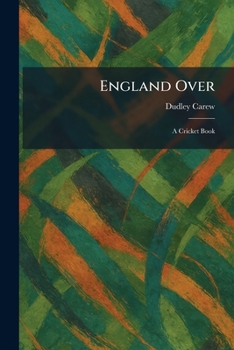
England Over: A Cricket Book

"England Over: A Cricket Book." is a lyrical and evocative exploration of the sport of cricket and its profound connection to the English landscape and identity. Written by Dudley Carew, a noted journalist and critic, the work captures the essence of the game during the interwar period, often referred to as a golden era for the sport. Through a series of reflective essays and observations, Carew weaves together the technicalities of the match with the atmospheric beauty of the English countryside, moving from the charm of the village green to the hallowed grounds of Lord's.
The narrative goes beyond mere statistics or match reports, focusing instead on the character of the players, the tension of the over, and the cultural significance of cricket as a cornerstone of national life. Carew's prose is infused with a deep appreciation for the rhythms of the season and the timeless appeal of the boundary rope and the leather ball. "England Over: A Cricket Book." remains a classic piece of sports literature, offering readers a nostalgic yet insightful look at a sport that mirrors the spirit and history of a nation. It is an essential read for enthusiasts of the game and those interested in the social history and literary depictions of early twentieth-century England.
This work has been selected by scholars as being culturally important, and is part of the knowledge base of civilization as we know it. This work was reproduced from the original artifact, and remains as true to the original work as possible. Therefore, you may see the original copyright references, library stamps (as most of these works have been housed in our most important libraries around the world), and other notations in the work.
This work is in the public domain in the United States of America, and possibly other nations. Within the United States, you may freely copy and distribute this work, as no entity (individual or corporate) has a copyright on the body of the work.
As a reproduction of a historical artifact, this work may contain missing or blurred pages, poor pictures, errant marks, etc. Scholars believe, and we concur, that this work is important enough to be preserved, reproduced, and made generally available to the public. We appreciate your support of the preservation process, and thank you for being an important part of keeping this knowledge alive and relevant.
Customer Reviews
ThriftBooks ® and the ThriftBooks ® logo are registered trademarks of Thrift Books Global, LLC
