


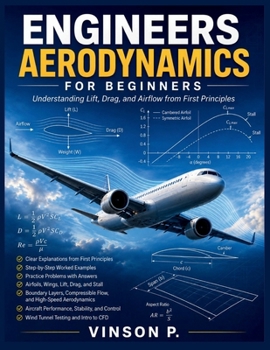
Engineers Aerodynamics for Beginners: Understanding Lift, Drag, and Airflow from First Principles

ENGINEERS AERODYNAMICS FOR BEGINNERS is a practical introduction to the principles that explain how air moves, how aircraft interact with airflow, and how aerodynamic forces are predicted and analyzed.
Starting from first principles, this book builds the reader's understanding step by step-from basic aerodynamics and the atmosphere to lift, drag, airfoils, wings, boundary layers, compressible flow, and high-speed aerodynamics.
Inside, you'll explore:
The fundamentals of aerodynamics and flight, including the four forces of flight and major flow regimes from subsonic to hypersonicThe atmosphere and standard atmospheric model, including pressure, temperature, density, altitude, and density-altitude effectsFluid mechanics fundamentals, including viscosity, continuity, Reynolds number, and flow behaviorFluid statics and pressure, including hydrostatic pressure, manometry, and aerodynamic pressure measurementBernoulli's equation and incompressible flow, with applications to the Venturi effect, Pitot-static systems, flow meters, and cavitationAirfoil and wing geometry, including NACA airfoil systems, chord, camber, thickness, aspect ratio, planform geometry, and wing twistLift generation and circulation theory, including pressure distributions, the Kutta condition, Kutta-Joukowski theorem, lift curves, and stallDrag and its origins, including skin friction, pressure drag, induced drag, drag polars, and strategies for reducing dragFinite-wing aerodynamics, including wingtip vortices, downwash, induced angle of attack, lifting-line theory, and aspect-ratio effectsBoundary-layer theory, including laminar and turbulent flow, transition, separation, adverse pressure gradients, and boundary-layer controlCompressible and high-speed flow, including Mach number, critical Mach number, compressibility corrections, normal and oblique shocks, drag rise, area ruling, and sonic boomsAerodynamic forces and moments, including lift, drag, pitching moments, center of pressure, and aerodynamic centerAircraft stability, control, and performance basics, including static margin, trim, elevator, aileron, rudder, glide performance, range, and enduranceExperimental aerodynamics, including wind-tunnel configurations, dimensional analysis, dynamic similarity, force measurement, pressure measurement, and uncertaintyComputational aerodynamics, including governing equations, discretization, computational meshes, panel methods, turbulence modeling, boundary conditions, and verification and validationThe book also includes worked examples, practice problems, answer keys, summaries, a list of symbols, glossary, standard-atmosphere tables, NACA airfoil references, unit conversions, and engineering constants to support study and review.
Whether you are beginning your study of aerodynamics, reviewing core engineering concepts, or looking for a structured reference to connect the mathematics with physical airflow, ENGINEERS AERODYNAMICS FOR BEGINNERS provides a progressive path from fundamental principles to modern aerodynamic analysis.
Build the foundation. Understand the physics. Connect the equations to real aerodynamic behavior.
Related Subjects
Engineering Science Science & Math Science & Scientists Science & Technology TechnologyCustomer Reviews
ThriftBooks ® and the ThriftBooks ® logo are registered trademarks of Thrift Books Global, LLC
