


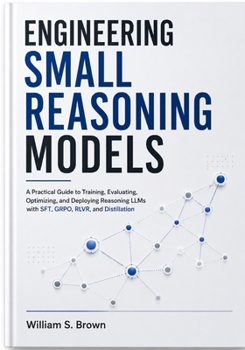
ENGINEERING SMALL REASONING MODELS: A Practical Guide to Training, Evaluating, Optimizing, and Deploying Reasoning LLMs with SFT, GRPO, RLVR, and Distillation

Build Smarter Reasoning Models-Without Frontier-Scale Hardware
Engineering Small Reasoning Models is a practical, implementation-focused guide for developers, AI engineers, and machine-learning practitioners who want to train compact language models to reason more effectively, efficiently, and reliably.
Rather than stopping at theory, this book walks you through a complete reasoning-model engineering pipeline from preparing high quality reasoning data and supervised fine-tuning to reinforcement learning, evaluation, optimization, compression, and local deployment.
You'll learn how to:
Create, filter, and verify high-quality reasoning datasets
Fine-tune compact models using SFT, LoRA, and QLoRA
Build rigorous evaluation pipelines for reasoning accuracy and efficiency
Design reliable verifiers and reward functions
Apply RLVR and GRPO to improve reasoning performance
Detect reward hacking and common reinforcement-learning failures
Reduce unnecessary reasoning tokens and control inference costs
Distill reasoning capabilities into smaller, faster models
Quantize models for efficient local inference
Deploy and monitor reasoning LLMs on accessible hardware
Throughout the book, one practical project evolves step by step from a compact open-weight base model into a trained, evaluated, optimized, quantized, and deployable reasoning system. Clear explanations, Python and PyTorch implementations, practical labs, troubleshooting guidance, benchmark workflows, and production considerations help you move from concepts to working systems.
Whether you are experimenting with reasoning LLMs, building specialized AI applications, exploring GRPO and RLVR, or trying to run capable models locally, this book gives you the engineering foundation needed to do it with confidence.
If you want to go beyond simply using reasoning models and learn how to train, evaluate, optimize, and deploy your own, Engineering Small Reasoning Models is the practical guide to get you there.
Customer Reviews
ThriftBooks ® and the ThriftBooks ® logo are registered trademarks of Thrift Books Global, LLC
