


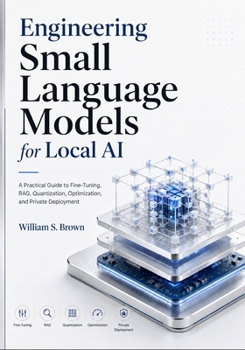
Engineering Small Language Models for Local AI: A Practical Guide to Fine-Tuning, RAG, Quantization, Optimization, and Private Deployment

Small Language Models are changing how practical AI systems are built. Instead of relying entirely on expensive cloud infrastructure, developers can now fine-tune, optimize, and deploy capable language models directly on laptops, workstations, and edge devices.
Engineering Small Language Models for Local AI is a practical, engineering-focused guide to building efficient, specialized AI systems from the ground up.
Inside, you will learn how to:
Select the right Small Language Model for your task and hardware
Prepare high-quality domain datasets for specialization
Fine-tune models using LoRA, QLoRA, and PEFT
Decide when to use RAG, fine-tuning, or hybrid architectures
Build reliable local retrieval and embedding pipelines
Evaluate model quality with practical, repeatable benchmarks
Apply quantization to reduce memory use and improve inference efficiency
Optimize latency, throughput, context handling, and hardware utilization
Deploy models privately using tools such as Hugging Face, Ollama, llama.cpp, ONNX Runtime, and MLX
Secure, monitor, and maintain production-ready local AI systems
Rather than overwhelming you with theory or massive code listings, this book follows a clear engineering workflow:
Define → Select → Benchmark → Prepare → Specialize → Ground → Evaluate → Quantize → Optimize → Deploy → Monitor
You will also work through realistic projects, troubleshooting scenarios, performance trade-offs, hardware considerations, and a complete production capstone that brings the entire workflow together.
Whether you are an AI engineer, software developer, data scientist, ML practitioner, or technically minded builder, this book will help you move beyond simply running open models and teach you how to engineer Small Language Models that are useful, efficient, private, and ready for real-world deployment.
Customer Reviews
ThriftBooks ® and the ThriftBooks ® logo are registered trademarks of Thrift Books Global, LLC
