


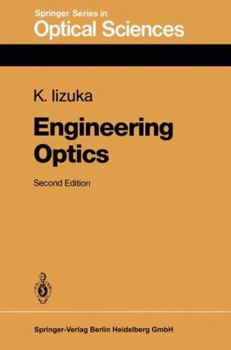
Engineering Optics (Springer Series in Optical Sciences)


Select Format
Select Condition 
Book Overview
The expanded 4th edition of this classic optics text is aimed at those wishing to apply their knowledge of optics to engineering problems, and provides a sound introduction to the basic principles of... This description may be from another edition of this product.
Format:Paperback
Language:English
ISBN:3540171312
ISBN13:9783540171317
Release Date:December 1986
Publisher:Springer
Weight:1.63 lbs.
Customer Reviews
2 ratings
A colourful and lively textbook on Optics
Published by Thriftbooks.com User , 17 years ago
I read the first edition of Professor Iizuka's Engineering Optics while an engineering undergraduate. No doubt the book was an eye-opener for me - suddenly, all the dreary mathematics and abstract concepts became lively and meaningful. Quoting Prof. Iizuka's own words--"Optics is Light Work", I found this book, filled with humorous cartoons and illustrations, certainly brought out the "light" in optics. More than a decade later, I am excited to read the third edition of this book. Now as an assistant professor teaching introductory optics to the undergraduate electrical engineering students, I find this book most helpful in demonstrating an effective approach to teaching optics to engineering students. It emphasizes practical applications of optical technologies. The mathematical formulae and derivations are used as a tool to help understand how things work, with helpful interpretations through many illustrations and apt analogies. The examples and problem sets at the end of each chapter are also helpful to students and instructors alike. Chapter 1 provides a historical review of important contributions in optics. Covering the optics development since 4000 B.C. to the present day in merely 24 pages, it outlines the milestone theories and experiments in the history of optics most succinctly and lively. Understandably, there are many omissions, but the purpose of this chapter is not to be exhaustive in covering the history of optics, but rather to serve as an "appetizer", to fascinate the young readers and lead them to explore more in this field that is both ancient and fast advancing. Chapter 2 lays down the basic mathematical tools used throughout the book, including the expressions of various types of waves and a short summary of Fourier Transform and Hankel Transform, which will be frequently used in later chapters on Fourier Optics. I found it very helpful to have a separate chapter focusing on the mathematical tools, making it more convenient for the readers to refer back to when needed. Chapters 3 and 4 analyze the diffraction phenomenon, followed by a selection of typical diffraction examples, such as the diffraction grating and the Fresnel Zone Plate. The scalar wave approach is used throughout, which I think is appropriate for the senior year undergraduate level or the introductory graduate level. Chapter 5 takes a different turn and discusses geometric optics. Unlike most textbooks where geometric optics is discussed independently of wave optics and focuses on lens systems, here the eikonal equation is derived from the wave equation, and is applied to solve for propagation constants in fibers and waveguides. Then, in Chapter 6, the convex lens is introduced, and the focus is on the Fourier Transform property of the lens. Chapter 7 is a separate chapter devoted to the Fast Fourier Transform method. It is a topic not specifically related to optics, and can be skipped without affecting the rest of the book. However, the reader may fin
Great link between optical theory and real world applications.
Published by Thriftbooks.com User , 18 years ago
I found this textbook a valuable source for solving real-world optical application problems. The back cover description summarizes it best. "Engineering Optics is a textbook for physics students who want to apply their knowledge of optics to engineering problems, as well as for engineering students who want to acquire the basic principles of optics. It covers such important topics as optical signal processing, holography, tomography, holographic radars, fiber optical communication, electro- and acousto-optic devices, and integrated optics (including optical bistability). As a basis for understanding these topics, the first few chapters give easy-to-follow explanations of diffraction theory, Fourier transforms, and geometrical optics. Practical examples, such as the video disk, the Fresnel zone plate, and many more, appear throughout the text, together with numerous solved exercises."
Copyright © 2026 Thriftbooks.com Terms of Use
| Privacy Policy | Do Not
Sell/Share My Personal Information | Cookie Policy | Cookie Preferences | Accessibility Statement
ThriftBooks® and the ThriftBooks® logo are registered trademarks of Thrift Books Global, LLC
ThriftBooks® and the ThriftBooks® logo are registered trademarks of Thrift Books Global, LLC
