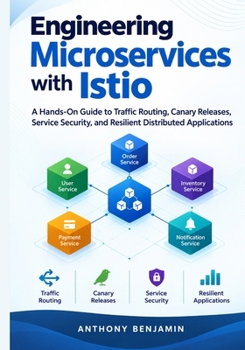
Engineering Microservices with Istio: A Hands-On Guide to Traffic Routing, Canary Releases, Service Security, and Resilient Distributed Applications

Build, secure, and operate resilient microservices with Istio.
As microservice architectures grow, managing communication between services becomes increasingly difficult. Teams must control traffic across versions, release changes safely, secure service-to-service requests, and diagnose failures that span multiple applications and infrastructure components.
Engineering Microservices with Istio: A Hands-On Guide to Traffic Routing, Canary Releases, Service Security, and Resilient Distributed Applications provides a practical approach to solving these challenges in Kubernetes environments.
Instead of focusing only on service-mesh concepts, this book explores how Istio can be applied to real engineering problems, with practical configurations, troubleshooting workflows, and production-focused examples.
Inside this book, you will discover how to:
Introduce Istio into an existing Kubernetes platform without disrupting running applications.
Configure traffic routing to direct requests safely between services and application versions.
Implement canary releases with measurable criteria for evaluating new deployments.
Configure retries and timeouts while avoiding additional load during dependency failures.
Secure service-to-service communication using workload identity, mutual TLS, and authorization policies.
Use mesh metrics, logs, and traces to investigate latency, errors, and request-path failures.
Diagnose Istio configuration problems involving services, endpoints, routing rules, security policies, and proxy behavior.
Validate configuration changes, manage rollouts, and prepare reliable rollback procedures.
Learn the engineering decisions behind the configuration.
A service mesh does not automatically make an application reliable. Incorrect routing can send requests to unavailable workloads, poorly designed retry policies can amplify outages, and restrictive security rules can block legitimate communication. This book explains how to recognize these risks, validate your assumptions, and make operational decisions based on evidence rather than guesswork.
You will also learn where Istio's responsibilities end. Application-level concerns such as transaction integrity, idempotency, and business authorization still require sound application design. Understanding this boundary helps you build a platform in which infrastructure capabilities complement rather than replace application logic.
Who should read this book?
This guide is designed for software developers, DevOps engineers, platform engineers, Kubernetes administrators, and cloud-native practitioners who want to use Istio to manage service communication more effectively. It is particularly useful for engineers moving from basic Kubernetes networking toward more controlled, observable, and secure microservice operations.
Whether you are introducing a service mesh for the first time or improving an existing Istio deployment, this book will help you make informed configuration choices, troubleshoot production problems systematically, and build safer release and recovery practices.
Take control of your service-to-service communication and build microservices that are easier to secure, observe, and operate in production.
Customer Reviews
ThriftBooks ® and the ThriftBooks ® logo are registered trademarks of Thrift Books Global, LLC