


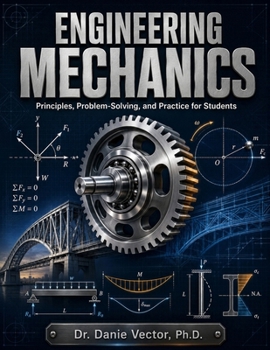
Engineering Mechanics: Principles, Problem-Solving, and Practice for Students

Build a strong foundation in the principles that govern forces, motion, structures, and material behavior.
Engineering Mechanics is a comprehensive, student-focused textbook designed to make engineering mechanics clear, rigorous, and practical. Written for undergraduate students in civil, mechanical, aerospace, structural, and related engineering disciplines, the book develops the analytical skills needed to solve mechanics problems confidently-from basic force systems to beam deflection and column buckling.
Rather than presenting mechanics as a collection of formulas to memorize, this textbook develops each major concept from first principles. Assumptions are clearly stated, equations are carefully derived, and the physical reasoning behind each method is explained. Worked examples guide readers through every important calculation, including diagrams, sign conventions, intermediate steps, units, checks, and final answers.
The book is organized into three progressive sections:
Statics: Equilibrium of BodiesReaders begin with the fundamental language of engineering mechanics, including units, dimensional analysis, numerical accuracy, Newton's laws, scalars, vectors, force components, and resultants. The statics section then develops essential methods for analyzing particles and rigid bodies in equilibrium.
Two-dimensional and three-dimensional force systemsFree-body diagramsParticle and rigid-body equilibriumMoments, couples, and equivalent force systemsSupport reactionsTrusses, frames, and machinesDistributed loads and centroidsCenters of gravityCoulomb friction, wedges, screws, and belt frictionDynamics: Motion of Particles and Rigid BodiesThe dynamics section explains how position, velocity, and acceleration are related to the forces and moments that produce motion. Students learn to select and apply the most suitable method for each problem rather than relying on a single memorized procedure.
Coverage includes:
Rectilinear and curvilinear motionProjectile motionNormal-tangential and polar coordinatesNewton's second lawWork and kinetic energyConservation of mechanical energyLinear and angular impulse-momentumImpact and coefficient of restitutionRelative velocity and accelerationInstantaneous centers of zero velocityMass moments of inertiaPlanar rigid-body kineticsMechanics of MaterialsThe final section connects external forces and motion to the stresses, strains, and deformations that develop inside engineering components. It provides students with an accessible introduction to the fundamental principles used in structural and mechanical design.
Normal and shear stressNormal and shear strainHooke's law and Poisson's ratioStress-strain behavior of engineering materialsAxial deformationStatically indeterminate membersTorsion of circular shaftsShear-force and bending-moment diagramsFlexural and transverse shear stressesCombined loadingBeam deflection by integration and superpositionEuler column bucklingFactors of safety and allowable-stress designEach chapter begins with clearly defined learning objectives and progresses from definitions and derivations to worked applications. Practice problems, chapter summaries, highlighted equations, engineering diagrams, and systematic solution procedures reinforce understanding and help students prepare for assignments, examinations, and more advanced engineering courses.
Customer Reviews
ThriftBooks ® and the ThriftBooks ® logo are registered trademarks of Thrift Books Global, LLC
