


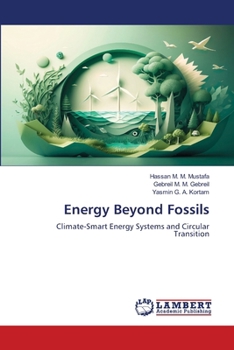
Energy Beyond Fossils
No Customer Reviews

The global energy transition is a complex system of systems driven by renewable energy, circular bioeconomy, artificial intelligence, and advanced biotechnologies. This book develops a systems engineering framework to analyze how these domains interact to shape energy efficiency, emissions reduction, and resource circularity using a descriptive-quantitative, multi-vector approach.Findings show that AI enhances forecasting, optimization, and real-time control, while synthetic biology improves bioenergy efficiency and feedstock flexibility. Circular economy integration strengthens performance through closed-loop resource recovery. Crucially, system integration-not individual technologies-is the main driver of effective decarbonization.However, key barriers remain, including infrastructure lock-in, scalability limits, and fragmented governance. The book concludes that future energy systems will be digitally coordinated, biologically enabled, and circular by design, requiring cross-sectoral integration to achieve net-zero pathways.
Format:Paperback
Language:English
ISBN:620990260X
ISBN13:9786209902604
Release Date:May 2026
Publisher:LAP Lambert Academic Publishing
Length:144 Pages
Weight:0.44 lbs.
Dimensions:0.3" x 6.0" x 9.0"
Customer Reviews
0 rating
Copyright © 2026 Thriftbooks.com
Terms of Use | Privacy Policy | Do Not Sell/Share My Personal Information | Cookie Policy | Cookie Preferences | Accessibility Statement
ThriftBooks ® and the ThriftBooks ® logo are registered trademarks of Thrift Books Global, LLC
ThriftBooks ® and the ThriftBooks ® logo are registered trademarks of Thrift Books Global, LLC
