


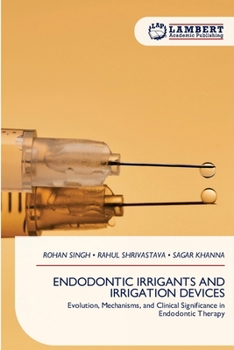
Endodontic Irrigants and Irrigation Devices
No Customer Reviews

Successful endodontic treatment depends on thorough cleaning, shaping, disinfection, and obturation of the root canal system. Mechanical instrumentation alone cannot completely eliminate microorganisms, necrotic tissue remnants, and debris from the complex anatomy of root canals. Therefore, irrigation plays a crucial role in enhancing canal cleanliness and improving treatment outcomes. Endodontic irrigants are chemical solutions used during root canal therapy to disinfect the canal system, dissolve organic tissues, remove the smear layer, lubricate instruments, and flush out debris. The effectiveness of irrigation is influenced not only by the chemical properties of the irrigants but also by the method of delivery and activation.The ideal endodontic irrigant should possess broad-spectrum antimicrobial activity, dissolve both vital and necrotic tissues, remove the smear layer, exhibit low toxicity to periapical tissues, and be stable, inexpensive, and easy to use. However, no single irrigant fulfills all these requirements. Consequently, modern endodontics relies on the sequential use of multiple irrigants and activation techniques to achieve optimal disinfection.
Format:Paperback
Language:English
ISBN:6630120663
ISBN13:9786630120660
Release Date:June 2026
Publisher:LAP Lambert Academic Publishing
Length:220 Pages
Weight:0.66 lbs.
Dimensions:0.5" x 6.0" x 9.0"
Customer Reviews
0 rating
Copyright © 2026 Thriftbooks.com
Terms of Use | Privacy Policy | Do Not Sell/Share My Personal Information | Cookie Notice | Cookie Preferences | Accessibility Statement
ThriftBooks ® and the ThriftBooks ® logo are registered trademarks of Thrift Books Global, LLC
ThriftBooks ® and the ThriftBooks ® logo are registered trademarks of Thrift Books Global, LLC
