


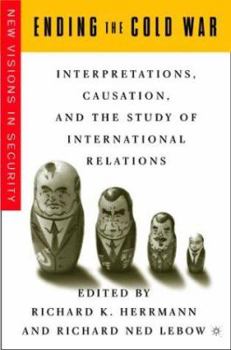
Ending the Cold War: Interpretations, Causation, and the Study of International Relations


Select Format
Select Condition 
Book Overview
2004
Format:Paperback
Language:English
ISBN:1403963843
ISBN13:9781403963840
Release Date:April 2004
Publisher:Palgrave Macmillan
Length:248 Pages
Weight:0.79 lbs.
Dimensions:0.6" x 6.1" x 9.1"
Customer Reviews
1 rating
is it still unresolved to some analysts?
Published by Thriftbooks.com User , 19 years ago
The reader gets a retrospective on the Cold War. Why it ended, and the salient turning points during this struggle. The most interesting section is at the start of the text, when the authors describe current Russian thinking. To some Russians, the Cold War was mostly initiated by the US, for hegemony. And that continuing US actions towards Russia reflect an ongoing attempt to hold down Russia. Some of these views might also be held by some Chinese, who worry about US hyperpower. It is a good reminder to the American reader that there are different world views held by others. Another interesting section dissects the events in eastern Europe in 1989-90, and the collapse of the Communist regimes. Gorbachev is of course the central figure in this drama. It is still a mystery to some why he did not take stronger measures, or ask the client Communist governments to apply more pressure. This would have plausibly delayed any collapse. But maybe nobody anticipated the events as they unfolded.
Copyright © 2026 Thriftbooks.com
Terms of Use | Privacy Policy | Do Not Sell/Share My Personal Information | Cookie Policy | Cookie Preferences | Accessibility Statement
ThriftBooks ® and the ThriftBooks ® logo are registered trademarks of Thrift Books Global, LLC
ThriftBooks ® and the ThriftBooks ® logo are registered trademarks of Thrift Books Global, LLC
