


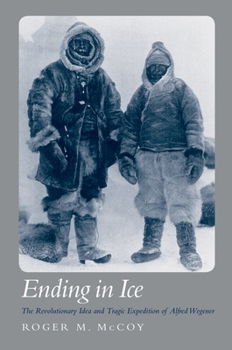
The Ending in Ice: The Revolutionary Idea and Tragic Expedition of Alfred Wegener

Select Format
Select Condition 
Book Overview
An old truism holds that a scientific discovery has three stages: first, people deny it is true; then they deny it is important; finally, they credit the wrong person. Alfred Wegener's "discovery" of continental drift went through each stage with unusual drama. In 1915, when he published his theory that the world's continents had once come together in a single landmass before splitting apart and drifting to their current positions, the world's geologists denied and scorned it. The scientific establishment's rejection of continental drift and plate tectonic theory is a story told often and well. Yet, there is an untold side to Wegener's life: he and his famous father-in-law, Wladimir K ppen (a climatologist whose classification of climates is still in use), became fascinated with climates of the geologic past. In the early 20th century Wegener made four expeditions to the then-uncharted Greenland icecap to gather data about climate variations (Greenland ice-core sampling continues to this day). Ending in Ice is about Wegener's explorations of Greenland, blending the science of ice ages and Wegener's continental drift measurements with the story of Wegener's fatal expedition trying to bring desperately needed food and fuel to workers at the central Greenland ice station of Eismitte in 1930. Arctic exploration books with tragic endings have become all too common, but this book combines Wegener's fatal adventures in Greenland with the relevant science--now more important than ever as global climate change becomes movie-worthy ("The Day After Tomorrow").
Format:Hardcover
Language:English
ISBN:0195188578
ISBN13:9780195188578
Release Date:June 2006
Publisher:Oxford University Press
Length:208 Pages
Weight:1.10 lbs.
Dimensions:0.8" x 7.2" x 9.4"
Customer Reviews
3 ratings
Alfred Wegener was a remarkable man...
Published by Thriftbooks.com User , 15 years ago
Alfred Wegener was a remarkable man, ahead of his time in many ideas and concepts. This book is a wonderful, yet tragic, tale of his life and work. As an explorer he was like a child, wide eyed and excited; but as a scientist he was cool and collected. The combination of the two created a man of substance, one that I would liked to have met.
Well informed, well written, and hard to put down
Published by Thriftbooks.com User , 17 years ago
There are two threads in this excellent but oddly titled little volume: How Alfred Wegener proposed continental drift two generations before the idea was accepted, and how he led the German meteorological expeditions to Greenland in the interwar years, expeditions that were successful despite ending in Wegener's death. It turns out there were good reasons to reject Wegener's drift hypothesis. Almost all his details were wrong. He thought the continents somehow picked up and walked across the crust; he thought - due to measurement errors - that North America had separated from Europe 10,000 years ago. Fortunately this book ably illuminates how the relevant science eventually came together. Continental drift makes no sense without plate tectonics, a notion developed when finally new evidence revealed the mid-ocean ridge building and the magnetic reversals encoded in the spreading new crust. There are several related discussions in this book, especially interesting the development of the orbital pertubation theory as a cause of the ice ages. (The groundbreaking Milutin Milankovic theory). It did not help Wegener either that he was educated as an astronomer, practiced meteorology, and published about paleogeology! As for the Greenland caper, this is a captivating account of what went wrong (not so much what went right - it's not about meteorology). A simple misunderstanding led to the catastrophic winter resupply mission to the central station, Eismitte. Good God! they should have had a radio there. And an airplane! I think most of this has not been readily available in English, though of course in German. McCoy draws heavily on the Wegener Institute in Bremerhaven, and, for photos, amusingly, on Fristrup's forty year old book on the Greenland Ice Cap. One could read this book as a case study in how scientific genius and crackpotism play tag. Wegener's core insight was true; but he had no credible evidence. An argument for open minds!
Kontinentalverschiebung = geopoetry?
Published by Thriftbooks.com User , 17 years ago
"Doesn't the east coast of South America fit exactly against the west coast of Africa, as if they had once been joined? This is an idea I'll have to pursue." So wrote Alfred Wegener in 1910 to his future wife. Pursue the idea Wegener did, in four major books and a number of lectures. (See especially the fourth edition: The Origin of Continents and Oceans.) Wegener's thesis: fossil and geological evidence clearly showed the continents were once connected, the current theory was based on land bridges that sank into the ocean, these bridges would have had to float up again since they were denser than the ocean floors, and the only logical alternative was that the continents themselves had been joined and had since drifted apart. Leading scientists were highly skeptical: "Utter, damned rot!" "If we are to believe this hypothesis, we must forget everything we have learned in the last 70 years and start all over again." Anyone who "valued his reputation for scientific sanity" would never dare support such a theory. The American Petroleum Society held a conference to demolish the theory. The oceanic crust was too firm for the continents "simply to plow through". Roger M. McCoy has written a wonderful biography describing Wegener's development of his theory of continental drift, and its triumphant acceptance 30 years after his death. McCoy also describes the accomplishments of Else Wegener in the years after Wegener's death (she died in 1992 at the age of 100). She wrote about her husband's work, including a book of his "diaries, letters and her own memories". McCoy also describes Wegener's accomplishments in climatology and ice age studies, in particular his four expeditions to the Greenland icecap to gather data about climate variations. Wegener was a record-holding balloonist, and he pioneered the use of weather balloons to track air masses. In 1912, his four-man expedition "escaped death only by a miracle" while climbing a suddenly calving glacier on the northeast coast of Greenland, then became the first to overwinter on the ice cap. The following spring, they made the longest crossing of the Greenland ice sheet, a traverse of 750 miles. His objective was scientific knowledge; he was the first to trace storm tracks over the ice cap. On his fourth trip, Wegener led a large group of scientists and technicians to Greenland in 1930. Wegener planned to establish three observation posts at latitude 71 degrees North, one on the western edge of the ice, one on the eastern edge, and one at mid-ice. The expedition went badly from the beginning (McCoy's descriptions have a wonderfully suspenseful character), and the party was over two months late in establishing the mid-ice camp, "Eismitte," on July 30. Eismitte was 250 miles inland at an elevation of 9,850 feet. (The eastern station was established later, by a separate party that landed on the east coast.) By mid-September, only a small portion of the supplies necessary for Eismitte had arrived. Wege
Copyright © 2025 Thriftbooks.com
Terms of Use | Privacy Policy | Do Not Sell/Share My Personal Information | Cookie Policy | Cookie Preferences | Accessibility Statement
ThriftBooks ® and the ThriftBooks ® logo are registered trademarks of Thrift Books Global, LLC
ThriftBooks ® and the ThriftBooks ® logo are registered trademarks of Thrift Books Global, LLC
