


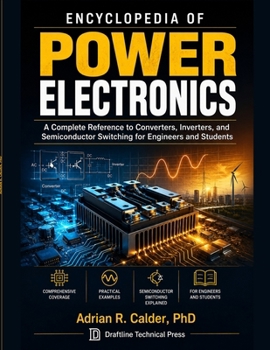
Encyclopedia of Power Electronics: A Complete Reference to Converters, Inverters, and Semiconductor Switching for Engineers and Students

Every design review eventually reaches a term that someone at the table cannot fully explain - a firing angle, a duty cycle, a modulation scheme, a datasheet parameter that quietly decides whether the design works. The answer is usually in a different book from the one on the desk.
That is the gap this A-to-Z reference is built to close. Engineers lose hours reconciling scattered sources, and students can run a topology in simulation yet struggle to justify the choices behind it. This book connects each idea to the decision it drives - showing not just what a quantity is, but how it shapes a real converter, inverter, or drive - and works every result through with the equations and examples that make the method usable.
After spending time with this guide you will be better able to:
See how firing angle, duty cycle, and modulation depth shape a converter or inverter output, with the governing relations derived in full.Connect datasheet parameters - holding and latching current, reverse recovery, junction temperature - to the design decisions they actually control.Compare converter and inverter topologies on the terms that matter in practice: loss, control behaviour, footprint, and suitability.Work through complete numeric examples, such as soft-starter voltage for a limited inrush or the end-to-end efficiency of a high-voltage DC link.Trace the cross-references from a single device to the systems that use it, so a component is never studied in isolation.Practical coverage runs from magnitude and phase-angle control, DC-DC conversion, and switch-mode supplies to rectifiers and reverse recovery, gate drive and switching behaviour, pulse-width and space-vector modulation, field-oriented and variable-frequency motor control, power factor correction, and thermal and heat-sink design - applied across electric-vehicle powertrains, battery charging and management, motor drives, renewable-energy conversion, and grid interconnection.
It is written for practising engineers who need fast, trustworthy answers during design and review, and for students and early-career engineers who want to understand - not merely operate - the circuits they build. A working knowledge of circuit analysis and elementary calculus is assumed.
Take the next step toward applying power-electronics ideas with confidence: open the book to the term in front of you and start turning it into a design decision you can defend.
Customer Reviews
ThriftBooks ® and the ThriftBooks ® logo are registered trademarks of Thrift Books Global, LLC
