


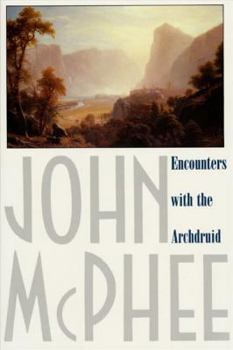
Encounters with the Archdruid: Narratives about a Conservationist and Three of His Natural Enemies


Select Format
Select Condition 
Book Overview
The narratives in this book are of journeys made in three wildernesses - on a coastal island, in a Western mountain range, and on the Colorado River in the Grand Canyon. The four men portrayed here have different relationships to their environment, and they encounter each other on mountain trails, in forests and rapids, sometimes with reserve, sometimes with friendliness, sometimes fighting hard across a philosophical divide.
Format:Paperback
Language:English
ISBN:0374514313
ISBN13:9780374514310
Release Date:October 1977
Publisher:Farrar, Straus and Giroux
Length:256 Pages
Weight:0.78 lbs.
Dimensions:0.7" x 5.2" x 8.7"
Customer Reviews
2 ratings
Arguably McPhee's finest book
Published by Thriftbooks.com User , 24 years ago
As the other reviewers here have noted, this is John McPhee's superb recounting of three episodes in the life of famous environmental activist David Brower. The three people he encounters are a geologist, a land developer, and a dam builder. The structure of the book allows a revealing contrast between one of America's greatest environmental activists on three key issues. These are: 1) the desirability and advisability of exploring and mining for ore and minerals in protected wilderness areas, 2) whether it is preferable to develop land on the Atlantic Coast or allow it to be developed, and 3) the desirability of damming major rivers in the Southwest.My favorite portion of the book featured Brower's encounter with the fascinating Charles Fraser, one of America's greatest and most gifted land developers. At debate was whether to develop Cumberland Island as a recreational and residential area, or whether to leave it wild and protect it as a National Seashore. The editorial reviewer inaccurately stated that Fraser was successful in his goal to develop it. He was not. Today Cumberland Island is a designated National Seashore. Fraser had hoped to develop Cumberland much as he had Hilton Head. What is compelling about Fraser is his desire to develop land on the one hand, with an intent to respect the physical surroundings to the greatest possible degree. Brower himself says in the book that while he is opposed to developing Cumberland Island, if anyone were to develop it, he would want Fraser to be that person.The section of the book in which Brower and dam builder Floyd Dominy discuss a wide range of issues is fascinating not just in contrasting two fundamentally opposed viewpoints, but in bringing out both Brower's most conspicuous success and failure. The success was his leading the Sierra Club in opposing building a dam in the Grand Canyon. The tragedy was that in focusing on opposing the Grand Canyon, Brower and the Sierra Club were unable to fight the building of the Glen Canyon River Dam, for environmentalists and conservationists perhaps the single greatest tragedy since the building of the Hetch Hetchy Dam early in the 20th century. In building this dam, the ironically named Lake Powell was created. Many environmentalists refer to his as Lake Foul. The irony stems from the fact that it was named in "honor" of John Wesley Powell, who led the first expedition of Europeans to explore the entirety of the Colorado River and the Grand Canyon. Powell was deeply opposed to the development of the American West beyond the ability of the water supply to support the local population. He would, therefore, have been horrified to find such an anti-monument as this lake bearing his name. Edward Abbey's books are filled with vituperative attacks on the devastation wrought by the building of the Glen Canyon River Dam. There are several organizations that continue calling for the draining of Lake Powell.Why is there so much outrage at this d
a generation passes...
Published by Thriftbooks.com User , 24 years ago
This was the book that introduced me to John McPhee (I grew up around the corner from Dave Brower)and it made me a lifelong fan of McPhees remarkable insights and abilities as a reporter. Here he takes Brower -probably the leading voice for landscape conservation in the second half of the 20th century- and puts him Up Close and Personal with three very remarkable antagonists: the greatest Dam builder in North America, the developer of Hilton Head, and with a mining engineer who has "an affinity for beds" -but has managed to spend nearly 8 years in total sleeping rough in search of minerals world-wide. What is most intriguing about this book is that one comes away with an appreciation of the complexities surrounding environmental issues. This is no polemic or one-sided rant, rather McPhee shows us the strengths and weaknesses of each of his characters, and by weaving the personal in with the political we are left to make up our own minds just who are the heroes and who the villains. Recently I used this book in an Environmental Lit. class & to my surprise about half of the students had never heard of Brower (hence the title of my review. In spite of this they were all captured by the artful transparency of McPhee's prose -they were on that raft with Dominy & Brower, they went up that mountain, they walked that beach, and most important, they had that conversation. Thirty years after its publication this book still has the zip to draw its reader in. Regardless of your position on Things Environmental, I encourage you to give this a good read.
Copyright © 2026 Thriftbooks.com
Terms of Use | Privacy Policy | Do Not Sell/Share My Personal Information | Cookie Policy | Cookie Preferences | Accessibility Statement
ThriftBooks ® and the ThriftBooks ® logo are registered trademarks of Thrift Books Global, LLC
ThriftBooks ® and the ThriftBooks ® logo are registered trademarks of Thrift Books Global, LLC
