


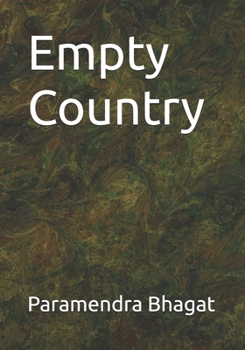
Empty Country

In Empty Country, a dystopian spark ignites a global renaissance. When President Donald Trump delivers a shocking televised speech ordering all undocumented immigrants to leave the United States within 24 hours, the result is neither chaos nor protest-but silence and movement. Without a word, millions obey. They lay down tools, remove aprons, close laptops, and begin walking south. On foot. Together.
As these workers vanish, the American economy begins to unravel. Crops rot, restaurants close, elders go unbathed, and the hidden scaffolding of society collapses. The rot is not just agricultural but moral and systemic. Into this vacuum, Mexico's President Claudia Sheinbaum issues an unprecedented invitation: a 50-by-50-mile plot of land in Northern Sonora is granted to the walkers to build anew-a special economic zone with no taxes and total autonomy.
What follows is one of the greatest acts of peaceful reinvention in human history. The migrants build ten-story housing with inner gardens, walkable neighborhoods, solar infrastructure, and free public transport. Schools emerge, hospitals are formed, libraries are born from tarps and milk crates. A city called Nueva Esperanza rises-not as a mirror of the America they left, but as an inversion of it.
As the city grows, so does its influence. Highly skilled immigrants and foreign-born U.S. citizens begin leaving America voluntarily to join the experiment. The "Exodus 2.0" begins. Esperanza becomes the prototype for a network of "Little Americas" across the Global South-from Kenya to Colombia to Nepal-each adapted to local needs but bound by shared values of cooperation, transparency, and civic contribution.
Back in the U.S., the vacuum deepens. Labor shortages become existential. The rich retreat into gated enclaves. Cities empty. Infrastructure fails. And in a historical twist, Americans begin migrating to the places once filled by those they cast out. North Sonora welcomes them-cautiously, conditionally-with the requirement that they contribute, learn, and live by new rules. A reverse migration is born.
In time, the model spreads globally. The Espera Grid links dozens of new cities into a planetary network of learning, trade, and governance. Citizenship becomes earned through participation. Education is global. Governance is open-source. Waste becomes resource. Cities no longer exploit-they garden.
By year ten, the Earth itself has changed. Borders blur. Culture flows. The Garden City Planet has arrived-not by decree, but by dignity. And it all began with a walk.
Empty Country is a speculative epic about migration, memory, collapse, and creation. It's a story of people who were once erased, rising to build not only a new kind of city-but a new kind of civilization.
Customer Reviews
ThriftBooks® and the ThriftBooks® logo are registered trademarks of Thrift Books Global, LLC
