


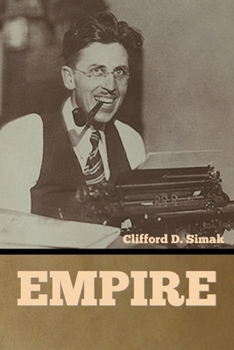
Empire

Select Format
Select Condition 
Book Overview
Clifford Donald Simak ( August 3, 1904 - April 25, 1988) was an American science fiction writer. He won three Hugo Awards and one Nebula Award. The Science Fiction Writers of America made him its third SFWA Grand Master, and the Horror Writers Association made him one of three inaugural winners of the Bram Stoker Award for Lifetime Achievement.
imak became interested in science fiction after reading the works of H. G. Wells as a child. His first contribution to the literature was "The World of the Red Sun", published by Hugo Gernsback in the December 1931 issue of Wonder Stories with one opening illustration by Frank R. Paul. Within a year he placed three more stories in Gernsback's pulp magazines and one in Astounding Stories, then edited by Harry Bates. But his only science fiction publication between 1932 and 1938 was "The Creator" (Marvel Tales #4, March-April 1935), a story with religious implications, which was then rare in the genre.
Once John W. Campbell, at the helm of Astounding from October 1937, began redefining the field, Simak returned and was a regular contributor to Astounding Science Fiction (as it was renamed in 1938) throughout the Golden Age of Science Fiction (1938-1950). At first, as in the 1939 serial novel Cosmic Engineers, he wrote in the tradition of the earlier "super science" subgenre that E. E. "Doc" Smith perfected, but he soon developed his own style, which is usually described as gentle and pastoral. During this period, Simak also published a number of war and western stories in pulp magazines. His best-known book may be City, a fix-up novel based on short stories with a common theme of mankind's eventual exodus from Earth.
Simak continued to produce award-nominated novels throughout the 1950s and 1960s. Aided by a friend, he continued writing and publishing science fiction and, later, fantasy, into his 80s. He believed that science fiction not rooted in scientific fact was responsible for the failure of the genre to be taken seriously, and stated his aim was to make the genre a part of what he called "realistic fiction." (wikipedia.org)
Customer Reviews
ThriftBooks ® and the ThriftBooks ® logo are registered trademarks of Thrift Books Global, LLC
