


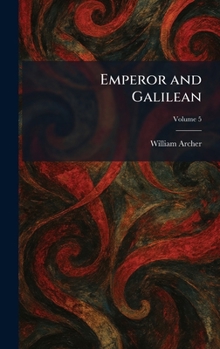
Emperor and Galilean

"Emperor and Galilean" is a monumental historical drama that Henrik Ibsen regarded as his most significant and ambitious work. This philosophical epic, categorized as a "world-historical drama," follows the life of the Roman Emperor Julian the Apostate during the fourth century. The play chronicles Julian's transition from a scholar of Christian theology to a defiant leader who seeks to restore paganism and the worship of the old gods to the Roman Empire.
Through a sweeping narrative divided into two parts-"Caesar's Apostasy" and "The Emperor Julian"-the work explores the profound spiritual and political conflict between the classical world and the rising influence of Christianity. Ibsen delves into Julian's internal struggle and his vision of a "Third Empire," a synthesis of the spirit and the senses that remains tantalizingly out of reach. This volume, prepared under the editorial guidance of William Archer, presents a masterful translation of Ibsen's complex exploration of destiny, power, and the evolution of human consciousness. "Emperor and Galilean" stands as a towering achievement in dramatic literature, offering a deep examination of the historical forces that shaped Western civilization and the tragic isolation of a ruler caught between two eras.
This work has been selected by scholars as being culturally important, and is part of the knowledge base of civilization as we know it. This work was reproduced from the original artifact, and remains as true to the original work as possible. Therefore, you may see the original copyright references, library stamps (as most of these works have been housed in our most important libraries around the world), and other notations in the work.
This work is in the public domain in the United States of America, and possibly other nations. Within the United States, you may freely copy and distribute this work, as no entity (individual or corporate) has a copyright on the body of the work.
As a reproduction of a historical artifact, this work may contain missing or blurred pages, poor pictures, errant marks, etc. Scholars believe, and we concur, that this work is important enough to be preserved, reproduced, and made generally available to the public. We appreciate your support of the preservation process, and thank you for being an important part of keeping this knowledge alive and relevant.
Customer Reviews
ThriftBooks ® and the ThriftBooks ® logo are registered trademarks of Thrift Books Global, LLC
