


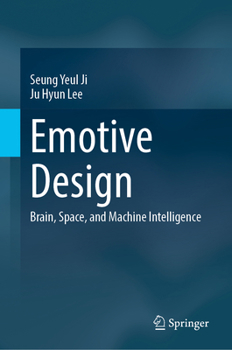
Emotive Design: Brain, Space, and Machine Intelligence
No Customer Reviews

This book presents emotive design as a new way of connecting design, neuroscience, and machine intelligence to understand and respond to human experience. It explains how human experience is sensed, interpreted, and translated into emotive design. Architecture and the built environment provide the principal context, while the framework has broader relevance to design fields concerned with engagement with physical and digital systems. The book is organised into three parts. Part I, Brain, establishes foundations through electroencephalography (EEG) and brain-computer interfaces, moving from brainwave-controlled vehicles to neuro-parametric feedback and responses to virtual environments. Part II, Space, examines human responses across spatial conditions, from compact housing to urban environments, before reconnecting measurement with physical adaptation in an EEG-informed shelter. Part III, Machine Intelligence, explores affective EEG datasets, cross-domain inference, and multimodal spatial mapping, linking computational interpretation to design conditions. Richly illustrated case studies, diagrams, and accessible explanations make developments in EEG and artificial intelligence accessible without requiring advanced technical knowledge. The book appeals to designers, architects, engineers, planners, researchers, educators, and students examining the affective and cognitive dimensions of design in the era of intelligent systems. Emotive design seeks not smarter environments, but more empathic and intelligible relationships among brain, space, and machine intelligence.
Format:Hardcover
Language:English
ISBN:3032444853
ISBN13:9783032444851
Release Date:April 2027
Publisher:Springer
Related Subjects
Art Arts, Music & Photography Computers Computers & Technology Engineering TechnologyCustomer Reviews
0 rating
Copyright © 2026 Thriftbooks.com
Terms of Use | Privacy Policy | Do Not Sell/Share My Personal Information | Cookie Notice | Cookie Preferences | Accessibility Statement
ThriftBooks ® and the ThriftBooks ® logo are registered trademarks of Thrift Books Global, LLC
ThriftBooks ® and the ThriftBooks ® logo are registered trademarks of Thrift Books Global, LLC
