


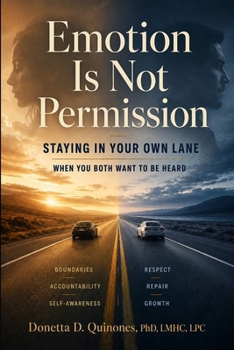
Emotion is Not Permission: Staying in Your Lane When You Both Want to Be Heard

You and your spouse understand each other perfectly. That is not the difficulty. The difficulty is that you keep having the same argument in different clothes - about the credit card, about her mother, about what time he said he would be home - and winning it has never once made either of you feel better.
Here is what is actually happening. A feeling arrives. It is real, it is often justified, and in the half-second before you decide anything it converts into something else: a permission. The right to raise your voice. The right to bring up what happened four years ago. The right to go quiet for two days.
The feeling was real. The permission was invented.
Dr. Donetta Quinones is a licensed clinician who has spent her career across from couples who love each other and cannot stop hurting each other. In Emotion Is Not Permission she offers a framework drawn from Micah 6:8 - the MICAH Relational Integrity Model(TM) - and one image that couples remember: two drivers, two lanes, one road. Staying in your own lane means your behavior is yours. Not your spouse's feelings, not their motives, not their opinion of you. Yours.
This book takes on what most Christian marriage books leave alone:
Power. Not abuse - the ordinary leverage every marriage contains. Money, silence, warmth, information, and Scripture itself. Enmeshment, correctly defined. It does not mean too close. It means closeness that has become mandatory. Guilt, shame, and pride - three doors into the same room, and why the spouse who cannot apologize and the spouse who cannot stop apologizing are often the same person raised in different houses. The one-flesh question. Does staying in your own lane contradict Genesis 2:24? An entire chapter answers it - and Galatians 6 has been answering it all along. When this book is the wrong book. A full chapter on coercive control, written to route the readers who need something else entirely.Every research claim in this book was checked against its primary source - and several are stated differently than you have read them elsewhere, because the popular version overstates what was actually found. Where the evidence is thin, Dr. Quinones says so.
Warm about your feelings. Unsentimental about your conduct. Written for two people who both want to be heard and have not managed it yet.
Includes a six-week guide for small groups and couples reading together.
Customer Reviews
ThriftBooks ® and the ThriftBooks ® logo are registered trademarks of Thrift Books Global, LLC
