


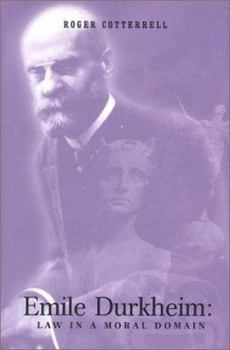
Emile Durkheim: Law in a Moral Domain (Jurists: Profiles in Legal Theory)
No Customer Reviews

This book seeks to provide a fully comprehensive and systematic account of Durkheim's legal theory. Indeed, because his writings on law and on the sociology of law are scattered throughout his work, this book is in fact the first attempt in English to provide a detailed analysis of the entirety of Durkheim's legal thought. The author argues that for Durkheim legal questions and moral questions were ultimately inseparable--not so much because law and morality cannot be analytically disentangled (as some legal philosophers argue), as because morality is embodied in the conditions of social life, the rules for which are articulated by law. Thus, for Durkheim, the study of law was an absolutely essential and central part of the sociological enterprise. Law aspires to express the moral commitments of people living in many different kinds of relationships of community, reflecting the values of those whose life it regulates. Durkheim's writings have a parallel aspiration: they use history, ethnography, and social theory to uncover the intricate and shifting moral foundations of law--foundations uncovered empirically by studying the social phenomena in which they reside, and by understanding the nature of those phenomena and the conditions of their being.
Format:Paperback
Language:English
ISBN:0804738238
ISBN13:9780804738231
Release Date:January 2000
Publisher:Stanford University Press
Length:288 Pages
Weight:1.15 lbs.
Dimensions:9.0" x 1.0" x 5.8"
Customer Reviews
0 rating
Copyright © 2026 Thriftbooks.com Terms of Use
| Privacy Policy | Do Not
Sell/Share My Personal Information | Cookie Policy | Cookie Preferences | Accessibility Statement
ThriftBooks® and the ThriftBooks® logo are registered trademarks of Thrift Books Global, LLC
ThriftBooks® and the ThriftBooks® logo are registered trademarks of Thrift Books Global, LLC
