


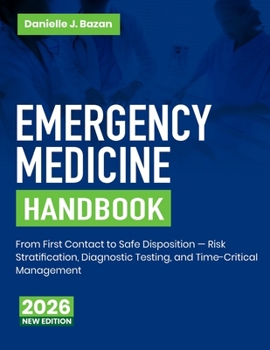
Emergency Medicine Handbook: From First Contact to Safe Disposition Risk Stratification, Diagnostic Testing, and Time-Critical Management
No Customer Reviews

Your patient's blood pressure is normal. Is that reassuring or is it the last thing about them that will be? The ECG shows no ST elevation. Does that mean the artery is open? The decision rule came back negative. Does that rule even apply to this patient? You gave tranexamic acid four hours after the injury. Did you help? Emergency medicine rarely asks you for a diagnosis. It asks you for a decision, and it asks before the diagnosis is available. This handbook is built around that gap. Organised by presentation rather than by diagnosis because a patient arrives short of breath, not carrying a label it follows fifteen high-stakes encounters from the door to a defensible disposition. WHAT YOU GET15 chapters across 5 parts: the structure of the emergency decision; resuscitation; time-critical medical presentations; infection, poisoning and metabolic crisis; trauma, special populations and disposition45 worked clinical scenarios with the arithmetic shown in full shock index, alteplase dosing, cerebral perfusion pressure, sodium correction ceilings, ventilator settings, post-test probabilityOver 45 original diagrams drawn for this book: annotated ECG patterns, the compensation curve, cerebral arterial territories, cricothyroid anatomy, lung ultrasound profiles, the paracetamol nomogram, pelvic binder placementMore than 60 reference tables, every drug dose given as a range with a local-formulary verification instruction105 practice questions with reasoned, boxed answersFour appendices, including a consolidated drug reference and a quick-reference guide to validated decision rules
WHY THIS ONEEvery decision rule is printed with its inclusion criteria and its documented failure mode because a rule applied outside the population that produced it is not evidenceEffect sizes are stated, not implied. An adequately powered negative trial is distinguished from an underpowered one, and both from an absence of evidenceWhere a widely taught practice rests on weaker foundations than its ubiquity suggests, the book says soRecommendations are stratified by resource level wherever the answer genuinely differs between a fully equipped department and one without a CT scanner or a blood bankWritten throughout in the second person: your patient, your assessment, your decisionWHO IT IS FOREmergency physicians. Acute care nurse practitioners and physician associates. Senior emergency medicine trainees. Internal medicine, family medicine and generalist physicians covering an emergency rota. Experienced emergency nurses and critical care outreach practitioners. If the decision to admit or discharge is yours to make and to defend, this book was written for you.
An independent work, designed to sit alongside your national formulary, your resuscitation council guidelines and your departmental protocols not to replace them. Scroll up and click Add to Cart to keep the reasoning with you on your next shift.
WHY THIS ONEEvery decision rule is printed with its inclusion criteria and its documented failure mode because a rule applied outside the population that produced it is not evidenceEffect sizes are stated, not implied. An adequately powered negative trial is distinguished from an underpowered one, and both from an absence of evidenceWhere a widely taught practice rests on weaker foundations than its ubiquity suggests, the book says soRecommendations are stratified by resource level wherever the answer genuinely differs between a fully equipped department and one without a CT scanner or a blood bankWritten throughout in the second person: your patient, your assessment, your decisionWHO IT IS FOREmergency physicians. Acute care nurse practitioners and physician associates. Senior emergency medicine trainees. Internal medicine, family medicine and generalist physicians covering an emergency rota. Experienced emergency nurses and critical care outreach practitioners. If the decision to admit or discharge is yours to make and to defend, this book was written for you.
An independent work, designed to sit alongside your national formulary, your resuscitation council guidelines and your departmental protocols not to replace them. Scroll up and click Add to Cart to keep the reasoning with you on your next shift.
Format:Paperback
Language:English
ISBN:B0HDT1CBVV
ISBN13:9798192064900
Release Date:August 2026
Publisher:Independently Published
Length:404 Pages
Weight:2.05 lbs.
Dimensions:0.8" x 8.5" x 11.0"
Customer Reviews
0 rating
Copyright © 2026 Thriftbooks.com
Terms of Use | Privacy Policy | Do Not Sell/Share My Personal Information | Cookie Notice | Cookie Preferences | Accessibility Statement
ThriftBooks ® and the ThriftBooks ® logo are registered trademarks of Thrift Books Global, LLC
ThriftBooks ® and the ThriftBooks ® logo are registered trademarks of Thrift Books Global, LLC
