


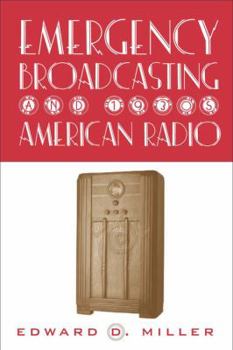
Emergency Broadcasting and 1930s American Radio

The voice we hear on the radio - the voice with no body attached - is a key element in the history of media in the twentieth century. Before television and the internet, there was radio; and much of what defined the makeup of these newer media was influenced by the way radio was broadcast to people and the way people listened to it. Emergency Broadcasting focuses on key moments in the history of early radio in order to come to an understanding of the role voice played in radio to describe national crises, a fictional invasion from outer space, and general entertainment. Taking the Hindenburg disaster, The War of the Worlds hoax, Franklin Roosevelt's Fireside Chats, and the serial mystery The Shadow as his focal points, Edward Miller illustrates how the radio, for the first time, instantly communicated to a mass audience, and how that communication - where the voice counts more than the image - is still at work today in television and the World Wide Web. Theoretically sophisticated yet grounded in historical detail, Emergency Broadcasting offers a unique examination of radio and at the same time develops a complex understanding of the media whose birth is owed to the innovations - a
Format:Hardcover
Language:English
ISBN:1566399920
ISBN13:9781566399920
Release Date:December 2002
Publisher:Temple University Press
Length:256 Pages
Weight:0.90 lbs.
Dimensions:0.8" x 4.7" x 9.5"
Customer Reviews
1 rating
Uncanny Pleasures: Review of Miller's Emergency Broadcasting
Published by Thriftbooks.com User , 22 years ago
Informed, stylishly written, and fun to read, Edward D. Miller's book Emergency Broadcasting is a must -- especially for anyone interested in a new take on the history of American radio.Miller skillfully connects radio's "intimate otherness" to various manifestations of the Uncanny (including Hamlet's Ghost, the delusions of paranoids and schizophrenics, and the voices of presidents). He does a close reading of three major broadcasting events of the '30s -- the reporting of the Hindenberg disaster; President Roosevelt's "Fireside Chats"; and Orson Welles's famous "War of the Worlds" broadcasts -- to show how radio both reassures and frightens the listener. A reinterpretation of the classical Echo and Narcissus myth in another chapter stretches his analogy about vocal disembodiment a bit too far into the ether. But Miller returns to earth to show the relevance of the myth to today's media landscape.The book concludes with a chapter drawing parallels between 1930s American radio and the Internet, which will, I'm sure, surprise and delight many students as well as critics of "the virtual community."-- Reviewed by Sumitra Mukerji
Copyright © 2026 Thriftbooks.com Terms of Use
| Privacy Policy | Do Not
Sell/Share My Personal Information | Cookie Policy | Cookie Preferences | Accessibility Statement
ThriftBooks® and the ThriftBooks® logo are registered trademarks of Thrift Books Global, LLC
ThriftBooks® and the ThriftBooks® logo are registered trademarks of Thrift Books Global, LLC
