


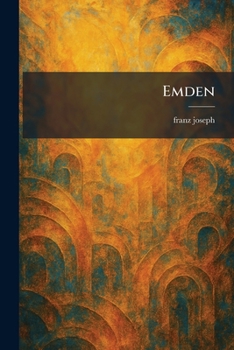
Emden

Select Format
Select Condition 
Book Overview
"Emden" offers a gripping first-hand account of one of the most famous naval sagas of World War I. Written by Prince Franz Joseph of Hohenzollern, an officer who served aboard the legendary light cruiser, this work details the ship's extraordinary journey and its impact on the maritime theater of the Great War.
The narrative follows the SMS Emden as it embarked on a solo raiding mission in the Indian Ocean, successfully disrupting Allied shipping lanes and engaging in daring maneuvers that earned the respect of both friend and foe. Prince Franz Joseph provides an intimate perspective on life at sea, the tactical brilliance of Captain Karl von M 1/4ller, and the chivalry that characterized the ship's interactions with captured crews. From the bombardment of Madras to the final battle at the Cocos Islands, the book captures the tension, strategy, and bravery inherent in early 20th-century naval combat.
As a significant piece of military history, "Emden" serves as both a memoir and a tactical record, preserving the legacy of a vessel that became a symbol of naval prowess. This account remains an essential resource for those interested in the history of the German Imperial Navy and the naval operations that defined the opening stages of the First World War.
This work has been selected by scholars as being culturally important, and is part of the knowledge base of civilization as we know it. This work was reproduced from the original artifact, and remains as true to the original work as possible. Therefore, you may see the original copyright references, library stamps (as most of these works have been housed in our most important libraries around the world), and other notations in the work.
This work is in the public domain in the United States of America, and possibly other nations. Within the United States, you may freely copy and distribute this work, as no entity (individual or corporate) has a copyright on the body of the work.
As a reproduction of a historical artifact, this work may contain missing or blurred pages, poor pictures, errant marks, etc. Scholars believe, and we concur, that this work is important enough to be preserved, reproduced, and made generally available to the public. We appreciate your support of the preservation process, and thank you for being an important part of keeping this knowledge alive and relevant.
Customer Reviews
ThriftBooks ® and the ThriftBooks ® logo are registered trademarks of Thrift Books Global, LLC
