


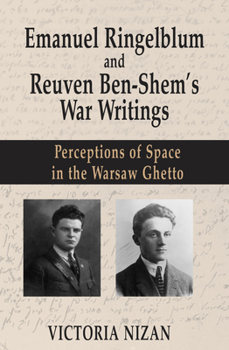
Emanuel Ringelblum and Reuven Ben-Shem's War Writings: Perceptions of Space in the Warsaw Ghetto
No Customer Reviews

The book explores how history and politics were expressed in the war writings of Emanuel Ringelblum and Reuven Ben-Shem, inmates at the Warsaw Ghetto. Each produced different accounts in purpose and style, Ringelblum's diary was a historical record whereas Ben-Shem wanted to inform the world what had happened to his family. Despite political differences, Jewish history defined both men's personal identity, and they derived moral and political inspiration from it. The range of topics and how they were recorded reflects traditional approaches to appropriacy, focussing predominantly on the public sphere, leaving us to speculate the private. The book examines relationships between physical spaces in the Ghetto, and how they were conceived: how writing reflected the disruption of Jewish spaces by blurring boundaries between the private and public spheres resulting in abjection. The more Jews were crowded into the dwindling space, the more the private became public. Nizan's innovation is creating a model using historical records, philosophy and literature to understand the interactions between people, spaces and conditions in the Ghetto, and the effect on its inhabitants and outsiders.
Format:Hardcover
Language:English
ISBN:1803710713
ISBN13:9781803710716
Release Date:January 2025
Publisher:Vallentine Mitchell
Length:310 Pages
Weight:1.32 lbs.
Dimensions:1.0" x 6.1" x 9.1"
Customer Reviews
0 rating
Copyright © 2026 Thriftbooks.com Terms of Use
| Privacy Policy | Do Not
Sell/Share My Personal Information | Cookie Policy | Cookie Preferences | Accessibility Statement
ThriftBooks® and the ThriftBooks® logo are registered trademarks of Thrift Books Global, LLC
ThriftBooks® and the ThriftBooks® logo are registered trademarks of Thrift Books Global, LLC
