


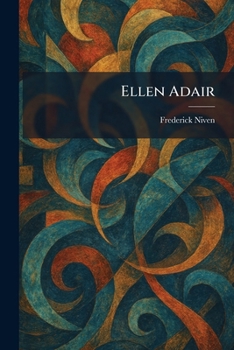
Ellen Adair

"Ellen Adair" is a poignant work of social realism by Frederick Niven that explores the complexities of class, vanity, and moral decline in early 20th-century Edinburgh. The novel centers on the eponymous Ellen Adair, a young woman whose beauty and longing for a more glamorous life lead her away from her modest, lower-middle-class upbringing. Unlike her industrious and grounded sister, Ellen is captivated by the superficial allure of society and the attentions of men, a path that ultimately leads to a tragic loss of reputation and a descent into the city's underbelly.
Through a meticulous depiction of the Scottish urban landscape and the rigid social structures of the era, Niven crafts a compelling psychological study of a family in crisis. The narrative offers a stark look at the limited options available to women of the period and the devastating consequences of societal judgment. "Ellen Adair" is recognized for its honest, unsentimental portrayal of human fallibility and remains a significant contribution to the tradition of the realistic novel. With its rich characterizations and evocative setting, Niven's work captures a transformative moment in literary history, providing a powerful examination of the human condition.
This work has been selected by scholars as being culturally important, and is part of the knowledge base of civilization as we know it. This work was reproduced from the original artifact, and remains as true to the original work as possible. Therefore, you may see the original copyright references, library stamps (as most of these works have been housed in our most important libraries around the world), and other notations in the work.
This work is in the public domain in the United States of America, and possibly other nations. Within the United States, you may freely copy and distribute this work, as no entity (individual or corporate) has a copyright on the body of the work.
As a reproduction of a historical artifact, this work may contain missing or blurred pages, poor pictures, errant marks, etc. Scholars believe, and we concur, that this work is important enough to be preserved, reproduced, and made generally available to the public. We appreciate your support of the preservation process, and thank you for being an important part of keeping this knowledge alive and relevant.
Customer Reviews
ThriftBooks ® and the ThriftBooks ® logo are registered trademarks of Thrift Books Global, LLC
