


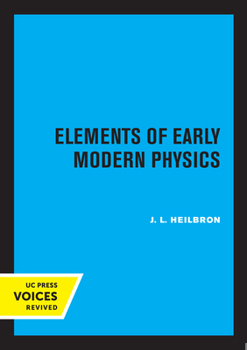
Elements of Early Modern Physics


Select Format
Select Condition 
Book Overview
Elements of Early Modern Physics comprises the two long introductory chapters of J. L. Heilbron's monumental work Electricity in the 17th and 18th Centuries: A Study of Early Modern Physics plus a concluding summary of the remaining chapters. Heilbron opens with a presentation of the general principles of physical theory and a description of the institutional frameworks in which physics were cultivated in the seventeenth and eighteenth centuries. He argues that the single most important contributor to physics in the seventeenth century was the Catholic Church. In the first half of the eighteenth century, Cartesian and Newtonian physicists disagreed over principles but thought in similar terms and cultivated the same sort of qualitative natural philosophy. Work towards an exact physics, which took on important dimensions after 1770, confounded the programs of both. Heilbron shows that by attending too closely to the Copernican revolution and the confrontation of great philosophical systems, historians have seriously misjudged the character of early modern science. This title is part of UC Press's Voices Revived program, which commemorates University of California Press's mission to seek out and cultivate the brightest minds and give them voice, reach, and impact. Drawing on a backlist dating to 1893, Voices Revived makes high-quality, peer-reviewed scholarship accessible once again using print-on-demand technology. This title was originally published in 1982.
Format:Paperback
Language:English
ISBN:0520302559
ISBN13:9780520302556
Release Date:March 2022
Publisher:University of California Press
Length:314 Pages
Weight:0.91 lbs.
Dimensions:0.7" x 5.8" x 8.3"
Customer Reviews
1 rating
Interesting history of electricity
Published by Thriftbooks.com User , 17 years ago
Part 1 is a very general and discursive survey of 17th century physics; Part 2 is a valuable comparison of the various institutional settings in which 17th and 18th century scientists worked; Part 3, the heart of the book, is a history of electricity up to about 1800. An interesting aspect of the history of electricity---one of which modern-day textbook authors should take note---is that it was pursued purely for fun, because people liked the cool experiments. For its first 70 years or so as a highly respectable scientific discipline, the field of electricity contained no numbers, no formulas, no mathematics. I will give some quotes to convey the excitement of this early era. In 1703, when Newton became its president, the Royal Society "wished to revive the healthy old custom, then disused for a generation, of showing experiments at the weekly meetings. The custom had been neglected not from disinterest or poverty but because it demanded a continual inventiveness that ultimately emptied even the ablest. To arouse the interest and stimulate the thinking of the heterogeneous fellowship required demonstration luciferous in philosophy, useful in art, ingenious in contrivance, and surprising and amusing in execution." (p. 168). Similarly, electricity was taken up by "playful German professors" (p. 179) who liked to "kill flies with sparks from their fingers" (p. 177). Soon the discovery of the Leyden jar enabled scientists to administer much more powerful shocks, which they immediately tried on themselves. Musschenbroek wrote to his friends at the Paris Academy explaining "how they too could blast themselves with electricity." "'I thought I was done for,'" he wrote, "adding precise directions for realizing the 'terrible experiment' and advice not to try it." The academicians could of course not resist "blasting themselves" right away and "reported bleedings, temporary paralysis, concussions, convolutions, and dizziness," with one person even "warning that his wife was unable to walk after he used her to shorten a Layden jar." (p. 184). "Science is a social enterprise. Let a gentleman hold the jar and a lady the PC; both feel the shock when they touch. How many others can be inserted in the train? Academician L. G. Le Monnier tried 140 courtiers, before the king; Nollet shocked 180 gendarmes in the same presence, and over 200 Cistercians in their monastery in Paris. 'It is singular to see the multitude of different gestures, and to hear the instantaneous exclamations of those surprised by the shock.' Only persons in the train felt the commotion; those in side chains branching from the main line felt nothing. Thus electricians discovered that the discharge---to use the word they introduced for the climax of the Leyden experiment---goes preferentially along the best conducting circuit ... In one demonstration only those at the extremes of the chain felt the shock, which appeared to avoid one of the company suspected 'of not possessing everything that
Copyright © 2026 Thriftbooks.com Terms of Use
| Privacy Policy | Do Not
Sell/Share My Personal Information | Cookie Policy | Cookie Preferences | Accessibility Statement
ThriftBooks® and the ThriftBooks® logo are registered trademarks of Thrift Books Global, LLC
ThriftBooks® and the ThriftBooks® logo are registered trademarks of Thrift Books Global, LLC
