
Skip to content
Scan a barcode
Scan
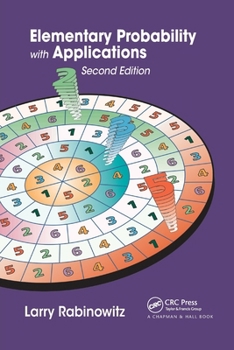
Paperback Elementary Probability with Applications Book

ISBN: 036739362X

ISBN13: 9780367393625

Elementary Probability with Applications

Select Format

Select Condition ThriftBooks Help Icon

Recommended

Format: Paperback

Condition: New

$94.99
On Backorder
If the item is not restocked at the end of 90 days, we will cancel your backorder and issue you a refund.
Usually restocks within 90 days
Save to List

Book Overview

Probability plays an essential role in making decisions in areas such as business, politics, and sports, among others. Professor Rabinowitz, based on many years of teaching, has created a textbook suited for classroom use as well as for self-study that is filled with hundreds of carefully chosen examples based on real-world case studies about sports, elections, drug testing, legal cases, population growth, business, and more. His approach is innovative, practical, and entertaining. Elementary Probability with Applications will serve to enhance classroom instruction, as well as benefit those who want to review the basics of probability at their own pace. The text is used at several colleges and for some high school classes.

Customer Reviews

3 ratings

Short, uncluttered, excellent

Very good choice as your first book on basic (discrete) probability. Lots of classical examples that you will encounter in more advanced classes too. The birthday problem, the occupancy problem, college grades and Simpson's paradox, medical diagnosis and Bayes' theorem, basic cryptology, simple English language models (the Shakespeare monkey) and many others. This book is a very good introduction to them. It uses the urn model to develop many solutions to problems, which is a good thing because that is a general and powerful model. Note that the book does not cover continuous distributions nor statistical inference.

Facile à lire, plein d'exemples et peu de théorie

Pour le présenter dans ces grandes lignes, ce livre est l'aboutissement des notes de cours d'un professeur qui est maintenant à la retraite. Il a été conçu pour un cours de probabilité pour sciences humaines. Il est constitué à peu près de 5% de théorie, 45% d'exemples et 50% d'exercices. L'approche y est fondamentalement appliquée. Les exemples ne sont pas de simples exercices résolus, on y explique le pourquoi et le comment. Cela en fait des guides d'utilisation. Dans la préface, l'auteur explique que, disons sur 5 sections d'un chapitre, il y en aura 4 qui couvrent la matière traditionnelle des probabilités et le 5ème aura de la matière plus avancée. On retrouve par exemple dans le premier chapitre (qui parle de définitions de base) une section sur les simulations Monte-Carlo. En passant à travers les exemples, je n'avais pas l'impression que les situations étaient artificielles. Les sujets traités étaient fort nombreux et variés. L'auteur cherchait à faire comprendre l'importance du langage dans les problèmes de probabilité. Par exemple, après avoir résolu une variante du problème classique des 2 personnes quelconque dans une même salle ayant le même anniversaire, il s'attarde à la compréhension et aux conclusions valables que l'on peut en tirer. Après quoi, il répond à un autre problème similairement posé (quelle est la probabilité que quelqu'un d'autre a le même anniversaire que « toi » ?) et fait remarquer que la réponse est tout autre.Bon livre, bon achat

Easy to read, lots of examples, little theory

To make a rough sketch of this book, this book is the end product of class notes of a now retired teacher. It was created for a course in probability for human sciences. The book has about 5% theory, 45% examples and 50% exercices. It's fundamentally an applied book. A teacher can use it in 2 ways : either "as is" or he can give his theory "without competition. The examples are not simple solved exercises, they explain the how and the why of things. That makes them user guides. In the foreword, the author explains that in a typical 5 section chapter, the first four will have the normal course matter, but the fifth will include extra "advanced" material. For example, in the first chapter (basic definitions), you'll find a section on monte-carlo simulations. Reading through the examples, I never had the impression they were artificial. The subjects were many and varied. The author tries hard to make the reader understand the importance of language in probability. For example, after having solved a variation of the identical birthday for 2 persons in a same room, he goes on the make sure that the reader sees what you can learn and what you cannot from such an example. He then goes on to solve another similar problem, namely that someone else has the same birthday that you do. We see that the answer is not the same...good read, good buy
Copyright © 2026 Thriftbooks.com Terms of Use | Privacy Policy | Do Not Sell/Share My Personal Information | Cookie Policy | Cookie Preferences | Accessibility Statement
ThriftBooks® and the ThriftBooks® logo are registered trademarks of Thrift Books Global, LLC

GoDaddy Verified and Secured