


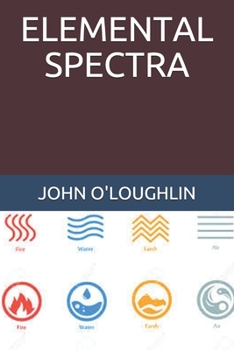
Elemental Spectra
No Customer Reviews

Originally dating from 1988-9 but now extensively revised, this major philosophical work investigates the significance of the four basic elements, viz., fire, water, earth, and air, with regard to a variety of different disciplinary contexts, including science, politics, economics and religion, and then seeks to draw ideological and moral lessons from the apperceived correlations. Of additional significance in relation to the Elements are the relationships between being and doing, awareness and emotion, mind and brain, nature and artifice, individualism and collectivism. There is also, within 'Elemental Spectra', a critique of Arthur Koestler's tripartite theories, as developed in books like 'The Act of Creation' and 'Janus - A Summing Up', as well as a refutation of the theory underlying his psychological pessimism concerning the dichotomous relationship between what he calls the 'old brain' and the 'new brain', roughly corresponding to the cerebellum and the cerebrum. In fact, Koestler is no less the principal philosophical target of this work than Schopenhauer was of 'Towards the Supernoumenon', its predecessor, and although the author acknowledges his debt to Koestler's influence on his thought, he was able to move beyond him at this point and accordingly dispense with a number of his theories. - A Centretruths Editorial.
Format:Paperback
Language:English
ISBN:150055930X
ISBN13:9781500559304
Release Date:July 2014
Publisher:Createspace Independent Publishing Platform
Length:236 Pages
Weight:0.71 lbs.
Dimensions:0.5" x 6.0" x 9.0"
Customer Reviews
0 rating
Copyright © 2026 Thriftbooks.com Terms of Use
| Privacy Policy | Do Not
Sell/Share My Personal Information | Cookie Policy | Cookie Preferences | Accessibility Statement
ThriftBooks® and the ThriftBooks® logo are registered trademarks of Thrift Books Global, LLC
ThriftBooks® and the ThriftBooks® logo are registered trademarks of Thrift Books Global, LLC
