


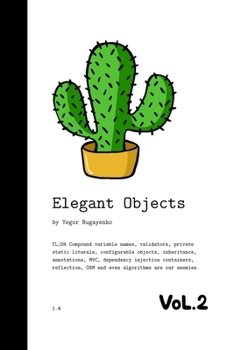
Elegant Objects

Object-oriented programming is a topic with more than fifty years of history. Few subjects in computer science and software engineering have generated as many books. Yet when the first volume of the Elegant Objects series was published, it became clear that many programmers still misunderstand what object-oriented programming actually is. The misunderstanding is not philosophical. It is practical, and its consequences are visible in everyday code: inconsistent design, fragile architecture, and software that becomes increasingly difficult to maintain.
This book presents an interpretation of OOP that differs significantly from what is described in most other texts, including many of the classical ones. The differences may seem unusual at first. Continue reading anyway. By the time you reach the end of the book-especially if you have read the first volume of the series-your understanding of object-oriented programming will likely change. More importantly, the software you produce will become easier to read, easier to modify, and easier to test.
In practical terms, the ideas presented here aim to simplify the act of programming. They focus on clear separation of concerns, strict isolation of functionality, disciplined avoidance of duplication, and deliberate support for reuse. When these principles are applied consistently, the complexity of the resulting software decreases even when the underlying problem remains complex.
The goal is not stylistic elegance for its own sake, but a more controlled and predictable way of building software. If the approach resonates with you, coding may begin to feel less like a struggle and more like a structured, manageable activity. Happy coding.
Customer Reviews
ThriftBooks ® and the ThriftBooks ® logo are registered trademarks of Thrift Books Global, LLC
