


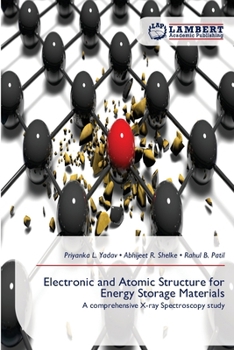
Electronic and Atomic Structure for Energy Storage Materials
No Customer Reviews

Research shows that introducing eg electrons through Mn3⁺ oxidation states enhances the electrochemical properties of MnO₂ compounds. When alkali metals (Na⁺, Li⁺, K⁺) are inserted into α- and β-MnO₂ structures, they cause topotactic Mn reduction and phase competition between the two forms. This cation insertion creates charge compensation and fast ion transport channels, improving charge storage and electrochemical performance, though the mechanism is not yet fully understood. During cycling, Na⁺ and K⁺ intercalation in α-MnO₂ induces a β-MnO₂ phase and facilitates Mn⁴⁺/Mn3⁺ redox transitions. Despite promising results, issues like cyclic stability, self-discharge, and corrosion remain. X-ray absorption spectroscopy (XAS), including XANES and EXAFS, is used to study these redox and structural changes. Overall, Na and K incorporation improves MnO₂ electrode stability and performance, offering potential for advanced supercapacitor applications. This study provide indetail understanding about the materials requirements for the energy storage applications in the context of electronic and atomic structure.
Format:Paperback
Language:English
ISBN:6209087477
ISBN13:9786209087479
Release Date:November 2025
Publisher:LAP Lambert Academic Publishing
Length:184 Pages
Weight:0.56 lbs.
Dimensions:0.4" x 6.0" x 9.0"
Customer Reviews
0 rating
Copyright © 2026 Thriftbooks.com Terms of Use
| Privacy Policy | Do Not
Sell/Share My Personal Information | Cookie Policy | Cookie Preferences | Accessibility Statement
ThriftBooks® and the ThriftBooks® logo are registered trademarks of Thrift Books Global, LLC
ThriftBooks® and the ThriftBooks® logo are registered trademarks of Thrift Books Global, LLC
