


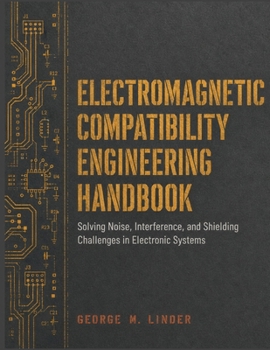
Electromagnetic Compatibility Engineering Handbook: Solving Noise, Interference, and Shielding Challenges in Electronic Systems
No Customer Reviews

A design passes every simulation and every bench test, then fails a radiated-emissions scan two weeks before a certification deadline - and the engineer staring at the spectrum analyzer has no clear way to tell which of a dozen possible fixes will actually work. That moment is familiar to almost anyone who designs electronic hardware. Electromagnetic compatibility is rarely taught as a coherent discipline; most engineers assemble it in fragments, picking up a favorite fix here and a rule of thumb there, without connecting them to the physical mechanisms underneath. That gap is expensive: an interference problem that costs almost nothing to prevent at the schematic stage can cost weeks of redesign once it surfaces in a compliance chamber, and a product that quietly passes one category of testing can still fail in the field because its immunity margin was never engineered in. As new technologies such as wide-bandgap power devices enter mainstream design, engineers who rely on memorized precedents rather than transferable principles find it hardest to adapt. This handbook helps engineers build electromagnetic compatibility competency from first principles rather than folklore. Across eighteen chapters, it applies a single recurring model - source, path, and receptor - consistently from the smallest package-level parasitic through board design, platform integration, regulated-industry certification, and organization-wide compliance program management. Inside, you will: Practice classifying real interference scenarios using the source-path-receptor model, and evaluate which mitigation - at the source, along the path, or at the receiving circuit - is most cost-effective at each stage of a program.Apply differential-mode and common-mode analysis to cabling, filtering, grounding, and digital circuit radiation problems, using fully worked numerical examples with every unit tracked.Design and evaluate shielding enclosures, power distribution networks, and return-current paths using calculated absorption, reflection, and target-impedance budgets rather than rules of thumb.Evaluate wide-bandgap power converter designs for power-loop inductance and gate-drive layout trade-offs specific to faster-switching devices.Navigate the regulatory distinctions between commercial, automotive, aerospace, medical, and industrial electromagnetic compatibility requirements.Apply a structured diagnostic workflow to precompliance measurement data, choosing the right detector, antenna, and test setup for the failure in front of you.Move from individual technical mastery to running a documented, repeatable compliance program across a full product lifecycle.Key topics include regulatory standards families; cabling, grounding, and bonding; filtering, isolation, and passive components; shielding and enclosure design; return-current physics and power distribution networks; digital circuit radiation and conducted emissions; wide-bandgap power electronics; platform-level radio desense; device- and package-level design; signal and power integrity co-design; immunity to ESD, RF, transients, and surge; safety-critical and regulated-industry design; precompliance measurement; and EMC compliance program management.
This handbook is written for practicing electrical, electronics, hardware, and power-electronics engineers; EMC and compliance specialists responsible for precompliance testing and regulatory submissions; engineers in automotive, aerospace, medical, and industrial contexts; engineering managers running a compliance program; and advanced students seeking a structured, example-driven course of study. Get your copy and discover a structured approach to the questions, challenges, and opportunities explored throughout the book.
This handbook is written for practicing electrical, electronics, hardware, and power-electronics engineers; EMC and compliance specialists responsible for precompliance testing and regulatory submissions; engineers in automotive, aerospace, medical, and industrial contexts; engineering managers running a compliance program; and advanced students seeking a structured, example-driven course of study. Get your copy and discover a structured approach to the questions, challenges, and opportunities explored throughout the book.
Format:Paperback
Language:English
ISBN:B0HB5JP853
ISBN13:9798188670948
Release Date:July 2026
Publisher:Independently Published
Length:524 Pages
Weight:2.65 lbs.
Dimensions:1.1" x 8.5" x 11.0"
Related Subjects
Engineering Science Science & Math Science & Scientists Science & Technology TechnologyCustomer Reviews
0 rating
Copyright © 2026 Thriftbooks.com
Terms of Use | Privacy Policy | Do Not Sell/Share My Personal Information | Cookie Policy | Cookie Preferences | Accessibility Statement
ThriftBooks ® and the ThriftBooks ® logo are registered trademarks of Thrift Books Global, LLC
ThriftBooks ® and the ThriftBooks ® logo are registered trademarks of Thrift Books Global, LLC
