


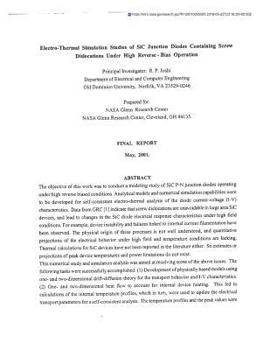
Electro-Thermal Simulation Studies of Sic Junction Diodes Containing Screw Dislocations Under High Reverse-Bias Operation
No Customer Reviews

The objective of this work was to conduct a modeling study of SiC P-N junction diodes operating under high reverse biased conditions. Analytical models and numerical simulation capabilities were to be developed for self-consistent electro-thermal analysis of the diode current-voltage (I-V) characteristics. Data from GRC indicate that screw dislocations are unavoidable in large area SiC devices, and lead to changes in the SiC diode electrical response characteristics under high field conditions. For example, device instability and failures linked to internal current filamentation have been observed. The physical origin of these processes is not well understood, and quantitative projections of the electrical behavior under high field and temperature conditions are lacking. Thermal calculations for SiC devices have not been reported in the literature either. So estimates or projections of peak device temperatures and power limitations do not exist. This numerical study and simulation analysis was aimed at resolving some of the above issues. The following tasks were successfully accomplished: (1) Development of physically based models using one- and two-dimensional drift-diffusion theory for the transport behavior and I-V characteristics; (2) One- and two-dimensional heat flow to account for internal device heating. This led to calculations of the internal temperature profiles, which in turn, were used to update the electrical transport parameters for a self-consistent analysis. The temperature profiles and the peak values were thus obtainable for a given device operating condition; (3) Inclusion of traps assumed to model the presence of internal screw dislocations running along the longitudinal direction; (4) Predictions of the operating characteristics with and without heating as a function of applied bias with and without traps. Both one and two-dimensional cases were implemented; (5) Assessment of device stability based on the operating characteristics. The presence
Format:Paperback
Language:English
ISBN:1723722472
ISBN13:9781723722479
Release Date:January 1
Publisher:Independently Published
Length:38 Pages
Weight:0.25 lbs.
Dimensions:0.1" x 8.5" x 11.0"
Customer Reviews
0 rating
Copyright © 2026 Thriftbooks.com Terms of Use
| Privacy Policy | Do Not
Sell/Share My Personal Information | Cookie Policy | Cookie Preferences | Accessibility Statement
ThriftBooks® and the ThriftBooks® logo are registered trademarks of Thrift Books Global, LLC
ThriftBooks® and the ThriftBooks® logo are registered trademarks of Thrift Books Global, LLC
