
Skip to content
Scan a barcode
Scan
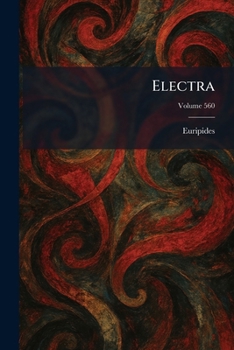
Paperback Electra Book

ISBN: 1025623800

ISBN13: 9781025623801

Electra

Select Format

Select Condition ThriftBooks Help Icon

Recommended

Format: Paperback

Condition: New

$18.24
Ships within 2-3 days
Save to List

Book Overview

"Electra" is a profound and unsettling Greek tragedy by the master playwright Euripides. Diverging from the more heroic interpretations of the myth found in the works of Aeschylus and Sophocles, Euripides presents a stark, psychological portrait of a family torn apart by violence and the relentless pursuit of vengeance. The story follows Electra, living in exile and poverty, as she plots with her brother Orestes to murder their mother, Clytemnestra, and her lover, Aegisthus, in retribution for the assassination of their father, Agamemnon.

Unlike other versions of the legend, Euripides's "Electra" focuses on the human consequences of the blood feud, depicting the characters with a realism that emphasizes their trauma and moral ambiguity. The play explores themes of social status, gender, and the cyclical nature of violence, questioning whether true justice can ever be achieved through further bloodshed. Known for its complex characterization and its critique of traditional heroic ideals, "Electra" remains a cornerstone of classical literature. This timeless work continues to resonate with modern audiences for its deep exploration of the human psyche and the heavy burden of duty and revenge.

This work has been selected by scholars as being culturally important, and is part of the knowledge base of civilization as we know it. This work was reproduced from the original artifact, and remains as true to the original work as possible. Therefore, you may see the original copyright references, library stamps (as most of these works have been housed in our most important libraries around the world), and other notations in the work.

This work is in the public domain in the United States of America, and possibly other nations. Within the United States, you may freely copy and distribute this work, as no entity (individual or corporate) has a copyright on the body of the work.

As a reproduction of a historical artifact, this work may contain missing or blurred pages, poor pictures, errant marks, etc. Scholars believe, and we concur, that this work is important enough to be preserved, reproduced, and made generally available to the public. We appreciate your support of the preservation process, and thank you for being an important part of keeping this knowledge alive and relevant.

Customer Reviews

2 ratings

Euripides turns Electra into a creature of vengeance

The murder of Clytemnestra by her son Orestes is unique in Greek mythology because we have versions of the tale staged by all three of the Greek tragic poets. One of the things that makes this remarkable, especially given how few of the ancient plays have survived to the present day (think of what it would be like if Shakespeare's work was reduced to about five plays), is that after Aeschylus wrote his version for "Cheophoroe," the central member of the "Orestia" triptych, any one would want to give a different telling of the tale. I think this interpretation is supported by two key points: first, that both Sophocles and Euripides titled their plays "Electra," focusing on the daughter/sister of the two main characters, and, second, that both of these other versions avoid having the pivotal scene between Clytemnestra and Orestes that is the dramatic highpoint of the Aeschylus play. The Euripides version of "Electra" is certainly representative of his dramatic work overall in that it focuses more on the psychology and emotions of the characters rather than the philosophical or spiritual implications. The murder of Clytemnestra by her son is no longer another sordid chapter in the curse on the house of Atreus and the appearance of the Dioscuri as a deus ex machina stands in stark contrast to the rest of the "Orestia." Still, Euripides ends the play on themes of sorrow as both Orestes and Electra can only speak of their remorse over what has happened and say their pathetical farewells to one another. Having finally found each other after years of separation, they are again forced apart by fate. As the chorus says at the end: "The moral who can fare well, not broken by trouble met on the road, leads a most blessed life." There are those who characterize this "Electra" as being more of a melodrama than a traditional tragedy, and that is certainly a valid interpretation. The Euripides version is clearly the weakest of the three, but that is almost by default. Aeschylus is creating the greatest trilogy in Greek history and Sophocles focuses on an Electra who is debating whether or not the responsibility for avenging the death of her father means that that the obligation to slay Clytemnestra falls to her. For Euripides the key twist is that when Electra reached maturity Aegisthus, the lover of Clytemnestra, feared that the young girl would marry some powerful prince and seek vengeance for the murder of Agamemnon. Aegisthus seeks to solve this problem by marrying Electra off to a peasant, who knows he is unworthy of the honor and has never consummated the marriage. Some critics have made light of Clytemnestra's refusal to condone the execution of her daughter given the fact she murdered her husband. But given that the prime reason for Agamemnon's murder was his sanctioning the sacrifice of their oldest daughter Iphigenia, the queen's decision seems consistent to me. This also fits with the idea that Electra is indeed the central character of the drama,

Euripides' version of the revenge of Agamemnon's murder.

This play by Euripides is another retelling of the story of the two children of Agamemnon, Electra and her brother Orestes, and their revenge of their father's murder. However, they are less heroic and more realistic then the way they are portrayed by Aeschylus and Sophocles. Electra has been given as a wife to a peasant who, although he is poor, realizes he is beneath her in station and does not touch her. Electra is constantly bemoaning her fate and prays for the return of her brother. Orestes appears in disguise to learn all that is happening around Argos and what has become of his sister. Electra finally recognizes him and they plan the death of Aegisthus and of their mother, Clytemnestra. But, Orestes is reluctant to commit matricide. Nevertheless, Electra drives him to it, even though, at the crucial moment, she herself is unable to deliver the killing stroke. Interestingly, the one truly noble and honest character in the play is the peasant. Was Euripides making a social comment about the upper classes of Athens of his time?
Copyright © 2026 Thriftbooks.com Terms of Use | Privacy Policy | Do Not Sell/Share My Personal Information | Cookie Policy | Cookie Preferences | Accessibility Statement
ThriftBooks ® and the ThriftBooks ® logo are registered trademarks of Thrift Books Global, LLC

GoDaddy Verified and Secured