


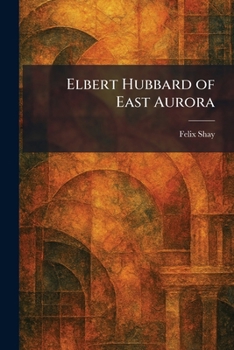
Elbert Hubbard of East Aurora

Select Format
Select Condition 
Book Overview
"Elbert Hubbard of East Aurora" offers an intimate and comprehensive look into the life and legacy of one of America's most eccentric and influential figures of the early 20th century. Written by Felix Shay, a close associate and member of the Roycroft community, this biography delves into the multifaceted persona of Elbert Hubbard-the writer, philosopher, and founder of the Roycrofters. Set against the backdrop of the Arts and Crafts movement in East Aurora, New York, the work captures the spirit of a man who transformed a small village into a world-renowned center for craftsmanship and intellectual exchange.
The book explores Hubbard's literary contributions, including his famous publication "The Philistine", and his most celebrated essay, "A Message to Garcia". Through Shay's personal anecdotes and first-hand observations, readers gain insight into Hubbard's unique philosophy on work, art, and life. This work serves as an essential historical record of the Roycroft experiment, highlighting its impact on American culture and the enduring relevance of Hubbard's rugged individualism and creative vision. It is a compelling study of a man who sought to harmonize manual labor with high art, leaving an indelible mark on the American landscape.
This work has been selected by scholars as being culturally important, and is part of the knowledge base of civilization as we know it. This work was reproduced from the original artifact, and remains as true to the original work as possible. Therefore, you may see the original copyright references, library stamps (as most of these works have been housed in our most important libraries around the world), and other notations in the work.
This work is in the public domain in the United States of America, and possibly other nations. Within the United States, you may freely copy and distribute this work, as no entity (individual or corporate) has a copyright on the body of the work.
As a reproduction of a historical artifact, this work may contain missing or blurred pages, poor pictures, errant marks, etc. Scholars believe, and we concur, that this work is important enough to be preserved, reproduced, and made generally available to the public. We appreciate your support of the preservation process, and thank you for being an important part of keeping this knowledge alive and relevant.
Customer Reviews
ThriftBooks ® and the ThriftBooks ® logo are registered trademarks of Thrift Books Global, LLC
