


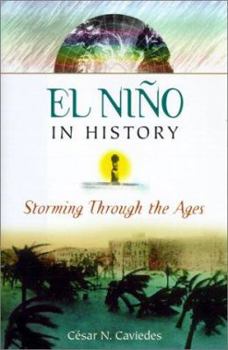
El Nino in History: Storming Through the Ages

C sar
Caviedes provides the first comprehensive historical account of El Ni o,
the fascinating and disruptive weather phenomenon that has affected
weather cycles all over the globe for thousands of years. Combining
scientific accuracy with readable presentation, he brings together all
existing information, references, and clues about past El Ni o
occurrences and their impact on political, military, social, economic,
and environmental history. This sweeping demonstration of the impact of
climatic fluctuation on human history will be fascinating to the
scientific community as well as to the general public.
From
the extraordinary discovery of Easter Island and Pizarro's conquest of
the Incas to the defeat of both Napoleon and Hitler in Russia and the
sinking of the Titanic, Caviedes shows how this enigmatic phenomenon has
swayed the course of history and human affairs. Searching historical
sources, traditional accounts, archaeological findings, and geological
evidence in North America, South America, and Europe, Caviedes discusses
in length the toll that El Ni os have taken on populations in various
parts of the world and offers an overview of La Ni a, the equally feared
twin.
Presenting basic concepts necessary to understand the
oceanic and meteorological processes associated with El Ni o, Caviedes
explains how air flows from the Pacific Ocean export heat and humidity
to distant parts of the world, describes the impact of these climatic
variations on ecological systems, and discusses the methods used to
track down past episodes of El Ni o and La Ni a. He also looks back at
the origins of the term El Ni o among regional fishermen in northern
Peru during colonial times and presents a compilation of El Ni o events
that have occurred in recent centuries.
Customer Reviews
El Niño in History. Storming through the ages.
Historically correct
El Niño in History
Excellent book to learn about the impacts of El Nino!
Great book about historical facts of "el Nino"
ThriftBooks ® and the ThriftBooks ® logo are registered trademarks of Thrift Books Global, LLC
