


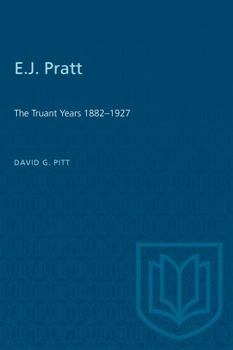
E.J. Pratt: The Truant Years 1882-1927

Select Format
Select Condition 
Book Overview
E.J. Pratt (1882-1964) is generally recognized as the leading Canadian poet of his generation. Moreover, as Marshall McLuhan observed in 1958, Pratt was, in his personal and social life, 'a one-man creator of a climate for the arts and letters in Canada.'
The Truant Years covers the first forty-five years of a full and eventful life. It provides an intimate account of life in the Newfoundland outports where Pratt grew up a sensitive boy in the family of a nomadic Methodist preacher. It describes his leaving school and home at age fifteen to spend three fruitless years working in St. John's; his return to school and reluctant enlistment in the Methodist ministry; and, after many adventures and misadventures, his arrival in Toronto to attend university and eventually to make a permanent home there.
'Ned' Pratt found his place at last in the practice of poetry and in the teaching of literature at Victoria College in the University of Toronto. With the publication of The Witches' Brew and Titans in 1926, he achieved both national acclaim as the premier new poet of Canada and international recognition as one of the best narrative poets of his time.
The Truant Years covers the first forty-five years of a full and eventful life. It provides an intimate account of life in the Newfoundland outports where Pratt grew up a sensitive boy in the family of a nomadic Methodist preacher. It describes his leaving school and home at age fifteen to spend three fruitless years working in St. John's; his return to school and reluctant enlistment in the Methodist ministry; and, after many adventures and misadventures, his arrival in Toronto to attend university and eventually to make a permanent home there.
'Ned' Pratt found his place at last in the practice of poetry and in the teaching of literature at Victoria College in the University of Toronto. With the publication of The Witches' Brew and Titans in 1926, he achieved both national acclaim as the premier new poet of Canada and international recognition as one of the best narrative poets of his time.
Format:Paperback
Language:English
ISBN:0802065635
ISBN13:9780802065636
Release Date:October 1984
Publisher:University of Toronto Press
Length:448 Pages
Weight:1.51 lbs.
Dimensions:1.0" x 6.1" x 9.2"
Grade Range:Postsecondary and higher
Customer Reviews
1 rating
A Rich Experience--Master Years Masterfully Done
Published by Thriftbooks.com User , 18 years ago
Being just apprised of the fact that my former Professor of English Romantic Poets, Dr. David Pitt, had been recently (2005) awarded an Honorary Degree at the insititution he helped mould (Memorial University of Newfoundland) and noting that no-one had yet ventured a review of his second volume of Newfoundland poet E.J. Pratt's life (The Master Years, 1927-1964), I try, as a loyal Newfoundlander trapped in the Palm Latitudes to rectify the oversight. Though listed as a Contemporary Author I can hardly claim the status of Literary Critic so these comments may be more indulgent than rigorous. Readers should know that Newfoundlanders are hopelessly chauvinistic (a "tribe" Professor Elizabeth Miller once told me) and find it hard to be objective about their own. Yet Pratt can lay fair claim to being Newfoundland and Labrador's preeminent person of letters. It was with a native's pride that I heard my Can Lit Prof at University of Toronto caution students about to read Pratt's "Towards the Last Spike" that he was a force in Canadian Lit but can be "very difficult." What Dr. Pitt has done in this justly acclaimed "magisterial" second volume is lay out the large and the small of Pratt's greatness--the lyric touches in his great epics. I like Pratt's modest versiifying such as "The English May was slipping into June" or "Black cavalry were astride the air" in his tribute to RAF airmen fighting the Luftwaffe in the dramatic "Dunkirk" or "the risk at Lloyd's remained a record low" in detailing the fate of "Titanic" or "The winds of God were blowing over France" in "Brebuf." Pitt devotes as much attention to the smaller touches as to Pratt's big themes--fair and balanced. One oversight is that Pitt does not attempt to set Pratt's accomplishment in the politico-cultural context of a North American society in its mid-20th Century heyday, recently victorious over a Depression and a World War and somewhat ideologically and forcefully unitarian as a result, "the good grey Canada" of the 1950's, something for which a younger generation of Newfoundland writers would understandably take Pratt to task. Pratt is a celebrator of Canada, and cooperative federalism and the nation-building agenda. He was a Lester Pearson Liberal. Yet Pratt writes heroically in almost guarded Hardyesque terms of the epic events that helped shape this still awkward, disparate nation. His subject matter unrolls in long, narrative epics along those lines--"Brebuf and His Brethren" (a sympathetic look at the French fact) and relentlessly, "Towards the Last Spike" which covers the building of the CPR as a technological and communitarian triumph. Pratt, in other words, works to a very large canvas indeed. How strange that this tribute to the building of Canada should come from a boy from Western Bay, NL who was born, not as a Canadian, but as a citizen of what was until 1949 a self-governing Dominion inside the British Empire. Yet, in Canada, the peripheral is often central and the Outsider
Copyright © 2026 Thriftbooks.com Terms of Use
| Privacy Policy | Do Not
Sell/Share My Personal Information | Cookie Policy | Cookie Preferences | Accessibility Statement
ThriftBooks® and the ThriftBooks® logo are registered trademarks of Thrift Books Global, LLC
ThriftBooks® and the ThriftBooks® logo are registered trademarks of Thrift Books Global, LLC
