


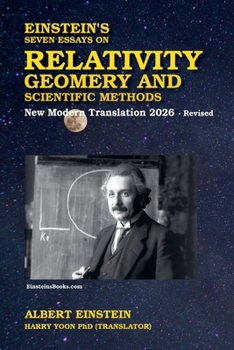
Einstein's Seven Essays on Relativity, Geometry, and Scientific Methods

# Einstein's Seven Essays on Relativity, Geometry, and Scientific Methods
**The Definitive Collection: Seven Seminal Works That Redefined Reality**
Step inside the mind of the 20th century's greatest thinker. This compilation brings together seven seminal essays and lectures written during the dawn of Albert Einstein's "Berlin Years" (1914-1921)-the period during which he rose to global fame and completed his masterpiece, General Relativity.
From his first public introductions to Relativity to profound reflections on the nature of space, time, and the scientific method, these works represent Einstein at the height of his powers. Written for general journals and newspapers, they offer a level of clarity and personal insight often missing from his technical papers.
**This volume includes: **
1. **On the Principle of Relativity (1914): ** A triumphant public introduction.
2. **On Principles in Theoretical Physics (1914): ** The philosophy behind his discovery.
3. **What is the Theory of Relativity? (1919): ** The definitive London Times masterclass.
4. **A Brief Account of the Development of Relativity (1921): ** The story of a revolution.
5. **Induction and Deduction in Physics (1919): ** Intuition vs. logic.
6. **Aether and the Theory of Relativity (1920): ** The birth of physical spacetime.
7. **Geometry and Experience (1921): ** The bridge between math and reality.
**Why this collection is essential: **
* **Modern Translations: ** Completely new renderings for the 21st-century reader, preserving Einstein's wit and logic.
* **Extensive Context: ** Translator's notes providing historical and technical background for each essay.
* **A True Understanding: ** Forget the "clumsy genius" stereotype; discover the deep philosopher-physicist who saw the universe differently.
The ultimate companion for students, scientists, and anyone seeking to comprehend the marvels of eternity and the structure of reality.
***
*"The important thing is not to stop questioning. Curiosity has its own reason for existence... Never lose a holy curiosity." - Albert Einstein, 1955*
Customer Reviews
ThriftBooks ® and the ThriftBooks ® logo are registered trademarks of Thrift Books Global, LLC
