


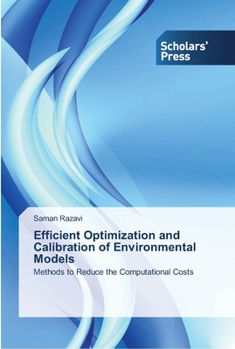
Efficient Optimization and Calibration of Environmental Models
No Customer Reviews

Advanced technologies have provided detailed spatiotemporal information about a variety of environmental variables and natural processes. Environmental model developers tend to make use of all available data and rigorously model all the detailed processes. Such practice may lead to highly complex models that demand large computational budgets to simulate the system. For example, a hydrologic or groundwater model representing a detailed conceptualization with a fine discretization level may demand hours (or even days) for a single run. Such computationally intensive models may be required to iteratively run many times (e.g., thousands of times) for various analyses including optimization, automatic calibration, design space exploration, sensitivity analysis, and uncertainty analysis, imposing prohibitively large computational burdens. This book is focused on the state-of-the-art concepts and methodologies for circumventing such computational challenges. Different approaches such as model pre-emption, surrogate modelling (metamodelling), and model reduction are discussed. Applications, benefits and drawbacks of different methods are demonstrated through multiple case studies.
Format:Paperback
Language:English
ISBN:3639517458
ISBN13:9783639517453
Release Date:September 2013
Publisher:Scholars' Press
Length:308 Pages
Weight:1.00 lbs.
Dimensions:0.7" x 6.0" x 9.0"
Customer Reviews
0 rating
Copyright © 2026 Thriftbooks.com Terms of Use
| Privacy Policy | Do Not
Sell/Share My Personal Information | Cookie Policy | Cookie Preferences | Accessibility Statement
ThriftBooks® and the ThriftBooks® logo are registered trademarks of Thrift Books Global, LLC
ThriftBooks® and the ThriftBooks® logo are registered trademarks of Thrift Books Global, LLC
