


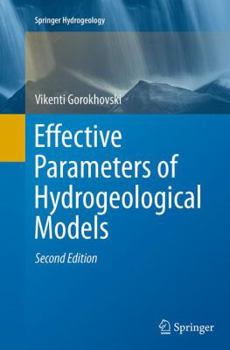
Effective Parameters of Hydrogeological Models
No Customer Reviews

Select Format
Select Condition 
Book Overview
Geological models used in predictive hydrogeological modeling are not exact replicas of the objects they represent: many details related to structures and properties of the objects remain unknown. Those details may considerably affect simulation results. A provable evaluation of the uncertainty of hydrogeological and solute transport simulations are almost impossible. In this book the author describes how to obtain the best-possible results in simulations, based on the available data and predefined criteria that are turned into transforming mechanisms. The latter are mathematical expressions for evaluating model parameters supporting effective simulations. Examples of the mechanisms as well as methods of their evaluation are provided in this book. It is also shown how these mechanisms can be used for the interpretation of hydrogeological data. The first edition of this book was published in the series Springer Briefs in Earth Sciences.
Format:Paperback
Language:English
ISBN:3319374559
ISBN13:9783319374550
Release Date:August 2016
Publisher:Springer
Length:182 Pages
Weight:0.65 lbs.
Dimensions:0.4" x 6.1" x 9.2"
Related Subjects
Engineering Science Science & Math Science & Scientists Science & Technology TechnologyCustomer Reviews
0 rating
Copyright © 2026 Thriftbooks.com Terms of Use
| Privacy Policy | Do Not
Sell/Share My Personal Information | Cookie Policy | Cookie Preferences | Accessibility Statement
ThriftBooks® and the ThriftBooks® logo are registered trademarks of Thrift Books Global, LLC
ThriftBooks® and the ThriftBooks® logo are registered trademarks of Thrift Books Global, LLC
