
Skip to content
Scan a barcode
Scan
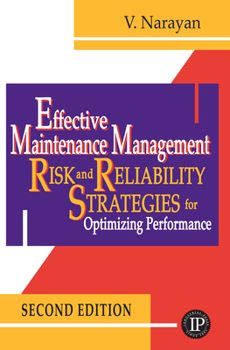
Hardcover Effective Maintenance Management: Risk and Reliability Strategies for Optimizing Performance Book

ISBN: 0831134445

ISBN13: 9780831134440

Effective Maintenance Management: Risk and Reliability Strategies for Optimizing Performance

Providing readers with a clear rationale for doing maintenance, this completely updated edition and unique guide is written in a language and style that practicing engineers and managers can understand and apply easily. Effective Maintenance Management examines the role of maintenance in minimizing the risks relating to safety or environmental incidents, adverse publicity, and loss of profitability. In addition to discussing risk reduction tools, it explains their applicability to specific situations so the readers can select the tool that fits their requirements. Aiding to bridge the gap between designers/maintainers and reliability engineers, this guide is sure to help businesses utilize their assets effectively, safely, and profitably.

Features

Provides a risk reduction model which links maintenance to these risks.Enables readers to make the link between maintenance on one hand and safety, profitability, and asset life on the other.Examines risks faced during the life cycle of a process plant.Discusses a high cost, high downtime maintenance activity, namely plant shutdowns.Provides an in-depth look at qualitative and quantitative risks.Includes a table of codes that can be used directly or adapted for use in most maintenance management systems.Keeps mathematics to a minimum.Includes chapter previews and summaries, a list of acronyms, and a glossary of terms.

Recommended

Format: Hardcover

Condition: New

$71.52
Save $8.43!
List Price $79.95
50 Available
Ships within 2-3 days

Customer Reviews

5 ratings

A very practical perspective on Maintenance Mangement

On Page 230 of this book, Vee makes a series of profound statements which summarise the book and its approach. He writes: "There are many learned papers that address the application of reliability engineering theory to maintenance strategy discussions. Many of them use advanced mathematics to fine tune maintenance strategies. The authors have limited access to field data, and their recommendations are often abstract and difficult to apply. So these remain learned papers, which practitioners do not understand or cannot apply to real life situations". He goes on to say later that "This chasm between the designers and maintainers on the one hand and the reliability engineers on the other is what we have to bridge" I can not agree more with these statements. While this book ventures into statistics and probability theory in some areas, it does so in a practical way and provides excellent guidance on such matters. Overall it is a practical book providing practical advice for people involved in maintenance and reliability management. It goes a long way to bridging the chasm that exists. This is a very good text that has a place in any maintainer's library.

The Essence of " Effective Maintenance Management, Risk & Reliability Strategies for optimizing p

Since the inception of sensible maintenance work culture which had been a refined terminology of repair for years together and which used to be considered as unwanted event being a cost center, no effort was made by industrial bigwigs to reform the approach to a structured, value added universal maintenance management system as focus was somewhere on market capturing by monopolized products clubbed with less competitive business arena and cultural drawback towards open and free sharing of information. The importance to pay reformative attention to upgrade the maintenance practices was felt in the beginning of 1960 and since then evolution in maintenance concepts & practices have become continuous and multi-directional. In course of this, scoring excellence in maintenance practices have become a inherent part of organization's commitment and much efforts are exerted by professionals to curb & realize the maintenance expenditure in terms of enhanced reliability by adopting formalized tools and functional approaches, so that maintenance no longer remains as cost center as it had been earlier. Unfortunately alike other management courses there is no formalized academic course exists on maintenance management, and continuous upgrade of maintenance management process grows based on sharing of information through different seminars conferences where knowledgeable & experienced maintenance professionals volunteer to educate the upcoming generation with the tips and key techniques to achieve excellence in maintenance performance. Respected Mr. V.Narayan is one such experienced personality and his book on " Effective Maintenance Management, Risk & Reliability Strategies for optimizing performance" provides a excellent overall insight that is essential to form a value added, cost effective maintenance management system. Among the content of book, the basic concept of functional system, the statistical approaches and mathematical insight to find out various inputs required to benchmark and optimize maintenance tasks, the concept and significance of various events/features associated with maintenance & overall reliability, the utilization process of various analytical decision making tools with area of applications, the inherent commitment associated with different strategic maintenance approaches, the technique to integrate safety and compliance to environmental regulation in maintenance philosophy are the most mentionable areas. The definition of system says, " It is an organized grouping of man, machine tools, equipment, instrument, procedure etc. collectively set to accomplish any task". This is very well explained in chapter 1 & 2 and attentive readers can grasp many important factual & practical learning points to enhance their teamwork and organizing capacity as well. The chapter 3 & 4 content mathematical approach and matrix to define and quantify various important statistics on failure rate, survival probability, and hazard rate, MTT

Comprehensive

That the author has managed to cram so much into 200 odd pages is impressive and I will be using it as a reference for some time. What is very good about the book is the ease of read and the fact that there are a number of real life examples that make many of your points more relevant to the reader. There were a few instances where my own experiences where reflected in the text such as Reshnikovs conundrum and the RCA chapter. On the whole I think it is an impressive book that deals well with a much misunderstood subject.

State-of-the-Art Maintenance Management

Effective Maintenance Management: Risk and Reliability Strategies for Optimising Performance By V. Narayan. Industrial Press, New York. ISBN 0-8311-3178-0 Review by Mahen Das, Asset Maintenance and Reliability consultant. Forty six years ago, soon after graduating as a mechanical engineer from a premier university in India, I joined the process industry. I was hired as a junior engineer and assigned as a trainee in the maintenance department. The concept of maintenance at that time, was, "tear it apart every so often, repair if anything inside is broken, and put it together again"; This was called preventive maintenance, If it broke down before its turn for preventive maintenance, as it often did, then run around like mad to fix it as quickly as possible. Top management was too distant; they did not want to know anything about maintenance as long as the broken it was repaired as soon as possible. There were very sharp boundaries between operators who ran the machines, the technologists who advised the operators on process technology, and maintainers who "fixed" the machines. As a result, in general (i.e outside very critical systems such as aircraft and nuclear plants) concepts such as operational reliability with a holistic approach were non-existent. No one had yet thought of applying statistical techniques to the practice of maintenance. The idea of total life-cycle cost of the plant and its optimization was still a few decades in the future. Over the last four decades, spurred by the increasing need for gaining the competitive edge, especially in the process industry where the cost of maintenance can be as high as 40% of the total operating cost, top management has started to take a very close look at maintenance. It is through the efforts of engineers such as Narayan that maintenance has today, reached the state it has. In this, his latest publication, Narayan covers all that was missing from the practice of maintenance 4 ½ decades ago. In a simple and very readable manner, he demonstrates how maintenance, reliability and costs are linked and how controlling (i.e. assessing, quantifying and, if necessary, reducing) risk is the key for improving performance in these areas. He also suggests tools and techniques with which the practicing maintenance engineer will be familiar. At the end of every chapter, there is a list of useful references and suggestions for further reading should the reader want to go deeper into any aspect in that chapter. All this is packaged in 246 pages in a very reader friendly type and font. In my opinion this is essential reading for all managers as well as maintenance practitioners in any industry where there is concern about maintenance and reliability of systems.

A Practical and Balanced Perspective

I come from a Reliability background which originated with a corporate R & D group of a Fortune 500 firm. Per our R & D efforts, we viewed Reliability Engineering as encompassing Equipment, Process and Human Reliability issues.Vee has concisely incorporated these three facets of Reliability into the Maintenance realm as well, allowing the reader to understand the big picture of developing an all-encompassing Maintenance and Reliability strategy. This "effective", all-encompassing strategy will consider the short-term and long-term objectives of the organization and identify the proper balance of reactive and proactive work to be optimally done. This book would also be an excellent desk reference for those who seek a foundation for terminology, as such standardized and accepted definitions are rare in our industry. Thanks Vee for sharing your expertise with others who can learn from your vast experience.
Copyright © 2025 Thriftbooks.com Terms of Use | Privacy Policy | Do Not Sell/Share My Personal Information | Cookie Policy | Cookie Preferences | Accessibility Statement
ThriftBooks ® and the ThriftBooks ® logo are registered trademarks of Thrift Books Global, LLC

GoDaddy Verified and Secured