


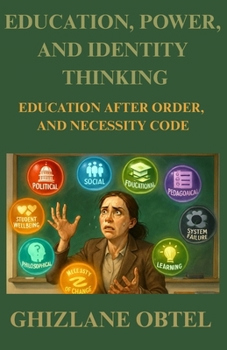
Education, Power, and Identity-Thinking: Education After Order, and Necessity Code

Introduction
Why does teaching feel impossible? Why do schools absorb society's conflicts? Why are teachers blamed for decisions they did not make? These questions lie at the heart of "Education, Power, and Identity-Thinking Societies: Education After Order, and Necessity Code". In contemporary democracies, education has become a locus where competing social, political, and moral claims converge. Teachers are required to implement curricula and policies they do not author, mediate social tensions they cannot resolve, and perform professional duties while under constant scrutiny from parents, communities, and political actors. The profession of teaching, once esteemed as a noble calling, is now rendered structurally vulnerable, socially exposed, and morally overburdened.
This book traces the mechanisms by which identity-driven politics hollow education from within. It shows how curriculum functions as a political script, how policy manufactures blame through bureaucratic abstraction, and how labor precarity ensures compliance in environments of social fragmentation. Teachers are made visible, accountable, and publicly culpable, yet they possess neither legislative authority nor control over the frameworks they implement. In performative democracies, they serve as sacrificial actors, absorbing social and political contradictions while the state preserves its image of moral virtue.
Education systems collapse under contradictory democratic demands precisely because they are expected to satisfy divergent social imperatives: equity, inclusion, national cohesion, historical truth, moral formation, and technical competence. This book demonstrates why teachers become the focal point of public anger despite lacking policy authority and how political institutions utilize technocratic governance as a stabilizing response. Technocracy emerges not as an ideological preference but as an adaptive mechanism: it preserves social function, ensures labor security, and protects political authority from accountability. Yet technocracy carries an intrinsic risk. By prioritizing specialization, technical execution, and measurable competencies over integrative understanding, it produces cognitive fragmentation, separating thought from meaning and expertise from wisdom.
Ultimately, societies cannot survive long without thinkers, wisdom, and integrative education. While technocratic structures may stabilize social order temporarily, they cannot restore the intellectual and moral cohesion necessary for civilizational resilience. This book identifies the conditions under which technocracy can operate without producing long-term social and cognitive stagnation, and argues for the essential integration of multidisciplinary pedagogy, collaborative inquiry, and philosophical reflection.
"Education, Power, and Identity-Thinking Societies: Education After Order, and Necessity Code" is therefore both diagnostic and prescriptive. It explains why contemporary education is under siege, analyzes the structural and political mechanisms producing this crisis, and charts a course toward educational systems capable of balancing professional stability, technical expertise, and intellectual depth. By tracing the interplay of power, policy, and pedagogy, the book illuminates not only the impossibility of teaching in fragmented societies but also the pathways through which education can recover its social, moral, and intellectual legitimacy.
Customer Reviews
ThriftBooks ® and the ThriftBooks ® logo are registered trademarks of Thrift Books Global, LLC
