


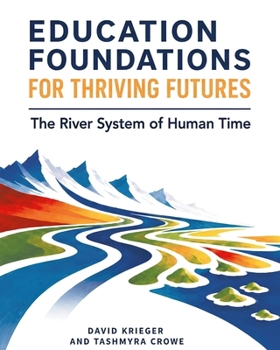
Education Foundations for Thriving Futures: The River System of Human Time

How can education prepare people to thrive through the social, ecological and technological changes extending towards the 22nd century?
Education Foundations for Thriving Futures explores this challenge through the River System of Human Time. This narrative map traces patterns in human capacities, relationships, knowledge, and organisation from our deep evolutionary origins to the Anthropocene present.
The journey begins at the present, where four trails introduce some of the people, knowledge traditions and research that contributed to the educational framework. From there, the River leads upstream towards humanity's Glacial Source before following two broad historical patterns, the Continuous Expansion and Regenerative Streams, and the Thresholds of Disconnection that changed relationships among people, communities, knowledge and place.
Drawing on natural and social sciences, Indigenous and local knowledge, history, economics and other knowledge traditions, the book brings different forms of accumulated human experience into a shared educational inquiry.
At the Anthropocene Delta, these tracks return to the present and to a central challenge: how can people participate thoughtfully in Regeneration Transitions when the future remains uncertain, and changes at local, institutional and global scales continually affect one another?
The educational framework develops through two complementary Learning Paths. The Narrative Path follows accumulated knowledge, evidence and stories across human time. The Experiential Path develops knowledge and capacities through observation, participation, tracking, dialogue, reflection and direct experience.
Both paths cross three connected educational domains:
Nature Connection and Earth Regeneration
Prosocial Connection and Community Regeneration
Universal Connection and Human Regeneration
The River System of Human Time and the Seven Directions Compass provide the map and navigation tools connecting these domains and Learning Paths.
The book aims to educate rather than prescribe. It does not present a completed model of a regenerative future. It provides ways to investigate how human systems developed, what different approaches have made possible, where important forms of disconnection have emerged, and what can be learned from regenerative practices across cultures, disciplines and generations.
The book can be read independently or used alongside the experiential courses and programs of the Thriving Futures 2100 education project. Through the Global Care Packs programs, its ideas are brought into direct experience through nature connection, community learning, tracking, research, dialogue, reflection and place-based practice.
thrivingfutures2100.com
Customer Reviews
ThriftBooks ® and the ThriftBooks ® logo are registered trademarks of Thrift Books Global, LLC
