


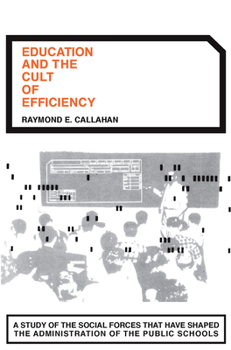
Education and the Cult of Efficiency


Select Format
Select Condition 
Book Overview
Raymond Callahan's lively study exposes the alarming lengths to which school administrators went, particularly in the period from 1910 to 1930, in sacrificing educational goals to the demands of business procedures. He suggests that even today the question still asked is: How can we operate our schools? Society has not yet learned to ask: How can we provide an excellent education for our children?
Format:Paperback
Language:English
ISBN:0226091503
ISBN13:9780226091501
Release Date:March 1964
Publisher:University of Chicago Press
Length:283 Pages
Weight:0.67 lbs.
Dimensions:0.6" x 5.4" x 7.9"
Customer Reviews
3 ratings
Conceptual Impoverishment of Education Administration
Published by Thriftbooks.com User , 15 years ago
Callahan's book is one of the most interesting histories of American education you'll ever read. The Cult of Efficiency neatly documents education decision makers' claims that they make choices based on established scientific principles, even though their training and professional experience leave them conceptually impoverished and devoid of science-based certainty. As a result, throughout the first decades of the Twentieth Century, when outsiders, especially self-certain, hard-nosed business people, demanded evidence of efficiency in education practice, they were given indiscriminant cost-cutting. Trained in the tradition of scientific management, often referred to as Taylorism, education decision makers had little or nothing else to offer. Taylorism, as developed in the last decades of the Nineteenth Century, is premised on the assumption that there is one best way to perform any task -- drive a nail, turn a screw, load a wheel barrow, wind a clock ... Perhaps the best known procedure derived from the ethos of Taylorism is the industrial engineer's time-and-motion study, aimed at finding the one most efficient way to organize any ensemble of simple tasks. When Tayloism is taken off the shop floor and applied to genuinely complex activities such as schooling the results are disastrous. Education policy making and administration are revealed for the conceptually impoverished disciplines that they are. Education decision makers are intellectually defenseless when faced with encroachment by outsiders convinced that they can do their jobs better. Hence wholesale, misguided cost-cutting as evidence that education, too, is a hard-nosed enterprise that knows how do identify and adopt efficiency measures in a disciplined and purposeful way. Over the past four decades, The Cult of Efficiency has been conspicuously manifest in standardized test-based accountability. George W. Bush's No Child Left Behind and Barack Obama's Race to the Top are premised on the patently dubious assumption that test-based accountability is the best response to any and all real or imagined education problems. Callahan would recognize this as nothing more than an extension of Nineteenth Century Taylorism, again revealing the conceptual thinness of the processes of education policy making and decision making. The psychometric and statistical tools have become quite complex, providing a densely technical cover for what is really going on, but the basic idea remains woefully simple-minded. The Cult of Efficiency reveals a perspective, rooted in a wrong-headed mind-set now more than a century old, that still governs education decision-making in the U.S.. Conceptually impoverished and lacking experience in the socially rich and informative world of the classroom, education decision makers keep making the same kinds of kinds of mistakes. A sad state of affairs, and one that Callahan understood and explained nearly fifty years ago.
A Classic of Education Research
Published by Thriftbooks.com User , 25 years ago
This fine readable book seems timeless in a new era of standardization and high-stakes testing in schools. The author, in brilliantly researched detail, demonstrates the institutionalization of alienation (the loss of control over the processes and products of labor) in U.S. schools. He traces the relationships of the rise of the mad career of F.E.W. Taylor, whose early 1900's management style sought to strip skilled industrial workers of their minds and skills, with parallel events in education. Coupled with the fascinating short film, "Clockwork," this book can be an important tool in grappling with questions about the reasons for authoritarian and apparently irrational approaches to schooling. Today, teachers still struggle for control of their workplaces. They battle the efforts to replace their minds in the classroom with the minds of test-publishers and standards writers whose partisan desires are rooted in dividing children even more deeply by race and class. The fight in schools is not only about production quotas, as the author shows, but about what people will know and how they will come to know it-and who makes those decisions. Hence, teachers, like their working class predecessors, can learn a lot from the history in this text which strips away the mysteries of why many schools look like they do.
A very critical look at the age of scientific management
Published by Thriftbooks.com User , 25 years ago
This text deals with the period of Taylor's scientific management and the attempt to apply this method to the school. It is harsh but fair in its appraisal of the empacts related to this period. In order to understand our schools today, it is a must read.
Copyright © 2026 Thriftbooks.com Terms of Use
| Privacy Policy | Do Not
Sell/Share My Personal Information | Cookie Policy | Cookie Preferences | Accessibility Statement
ThriftBooks® and the ThriftBooks® logo are registered trademarks of Thrift Books Global, LLC
ThriftBooks® and the ThriftBooks® logo are registered trademarks of Thrift Books Global, LLC
