


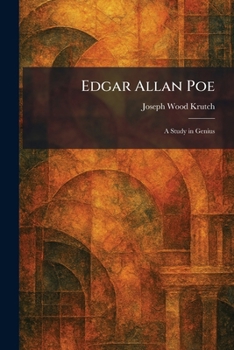
Edgar Allan Poe: A Study in Genius

Select Format
Select Condition 
Book Overview
"Edgar Allan Poe: A Study in Genius" is a seminal psychological biography that delves into the complex mind of one of America's most influential literary figures. Joseph Wood Krutch employs a psychoanalytic approach to explore the intricate relationship between Poe's turbulent life and his groundbreaking creative output. By examining the anxieties, obsessions, and environmental factors that shaped his character, Krutch offers a profound investigation into the nature of genius and the origins of the macabre themes that define Poe's poetry and prose.
The work provides a detailed analysis of Poe's most famous writings, positioning them within the context of his psychological struggles. It moves beyond traditional biography to offer a critical interpretation of how personal tragedy and mental instability fueled the creation of "The Raven," "The Fall of the House of Usher," and other classic tales of terror and deduction. This study is an essential resource for those interested in American literature, Gothic fiction, and the psychological dimensions of artistic creation, presenting a compelling portrait of a man whose legacy continues to haunt and fascinate the literary world.
This work has been selected by scholars as being culturally important, and is part of the knowledge base of civilization as we know it. This work was reproduced from the original artifact, and remains as true to the original work as possible. Therefore, you may see the original copyright references, library stamps (as most of these works have been housed in our most important libraries around the world), and other notations in the work.
This work is in the public domain in the United States of America, and possibly other nations. Within the United States, you may freely copy and distribute this work, as no entity (individual or corporate) has a copyright on the body of the work.
As a reproduction of a historical artifact, this work may contain missing or blurred pages, poor pictures, errant marks, etc. Scholars believe, and we concur, that this work is important enough to be preserved, reproduced, and made generally available to the public. We appreciate your support of the preservation process, and thank you for being an important part of keeping this knowledge alive and relevant.
Customer Reviews
ThriftBooks ® and the ThriftBooks ® logo are registered trademarks of Thrift Books Global, LLC
