


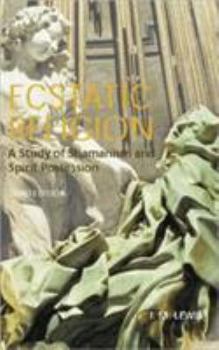
Ecstatic Religion: A Study of Shamanism and Spirit Possession


Select Format
Select Condition 
Book Overview
First Published in 2004. States of spirit possession, in which believer's feel themselves to be 'possessed' by the deity and raised to a new plane of existence, are found in almost all known religions. From Dionysiac cults to Haitia voodoo, Christian and Sufi mysticism to shamanic ritual, the rapture and frenzy of ecstatic experience forms an iconic expression of faith in all its devastating power and unpredictability. Ecstatic Religion has, since its first appearance in 1971, became the classic investigative study of these phenomena. Exploring the social and political significance of spiritual ecstasy and possession, it concerns the distinct types of functions of mystical experience - in particular, the differences between powerful male-dominated possession cults which reinforce established morality and power, and marginal, renegade ecstatics expressing forms of protest on behalf of the oppressed, especially women.
I. M. Lewis's wide-ranging comparative study looks at the psychological, medical, aesthetic, religious and cultural aspects of possession, and covers themes including soul-loss, ecstatic trance, divination, erotic passion and exorcism. Probing the mysteries of spirit possession through the critical lens of anthropological and sociological theory, this fully revised and expanded Third Edition is of crucial importance for students of psychology, sociology, religious mysticism and shamanism.
I. M. Lewis's wide-ranging comparative study looks at the psychological, medical, aesthetic, religious and cultural aspects of possession, and covers themes including soul-loss, ecstatic trance, divination, erotic passion and exorcism. Probing the mysteries of spirit possession through the critical lens of anthropological and sociological theory, this fully revised and expanded Third Edition is of crucial importance for students of psychology, sociology, religious mysticism and shamanism.
Format:Paperback
Language:English
ISBN:0415301246
ISBN13:9780415301244
Release Date:December 2002
Publisher:Taylor & Francis Group
Length:212 Pages
Weight:0.60 lbs.
Dimensions:0.5" x 8.4" x 6.3"
Customer Reviews
1 rating
Ecstatic Religion: A Study of Shamanism and Spirit Possessio
Published by Thriftbooks.com User , 26 years ago
I. M. Lewis's Ecstatic Religion is probably the most important place to begin study of the fields of spirit possession and shamanism. This book has deeply influenced the study of these fields of research since it was first published in 1971. Like most anthropologists, Lewis seeks to determine the social etiology and meaning of possession as well as its culturally determined psychological dimensions. He seriously examines trance, ecstasy, hypnosis, and shamanism, ultimately concluding that the latter shares an important process with possession-a reciprocity between gods and humans. He develops two contrasting psychosocial loci of possession which he labels "central" and "peripheral." Central possession, highly valued by some, supports prevailing political, moral, and religious beliefs, and views spirits as sympathetic to these. Peripheral possession indicates an invasion of evil spirits, undesirable, immoral, and dangerous. Lewis's work, while much cited and admired, has also been the target of extensive criticism. Perhaps primary among these criticisms is that his distinction between centrality and peripherality becomes highly ambiguous upon close contextual analysis. A second criticism is that many possession states do not share with shamanism the essential feature of reciprocity. A third criticism is that although Lewis is largely free from Western cultural biases, his characteristic terms "ecstasy" and "ecstatic" are drawn from Western theological discourse and cannot be applied unhesitatingly to many possession accounts. Lewis describes ecstasy as "those transports of mystical exaltation in which man's whole being seems to fuse in a glorious communion with the divinity" (15). This is similar to only a fraction of possession states observed in throughout the world. A fourth critique, and perhaps the sharpest one, is his association of possession with marginalized people, his assumption that possession provides the powerless with a means to symbolically express social, economic, or political oppression. While many of the contexts of possession worldwide seem to confirm this, the preponderance of the evidence in many countries bears this out in only the most superficial manner, possesssion, trance channeling, etc., have become increasingly middle-class phenomena. Nevertheless, this a very important and valuable book.
Copyright © 2026 Thriftbooks.com
Terms of Use | Privacy Policy | Do Not Sell/Share My Personal Information | Cookie Policy | Cookie Preferences | Accessibility Statement
ThriftBooks ® and the ThriftBooks ® logo are registered trademarks of Thrift Books Global, LLC
ThriftBooks ® and the ThriftBooks ® logo are registered trademarks of Thrift Books Global, LLC
