


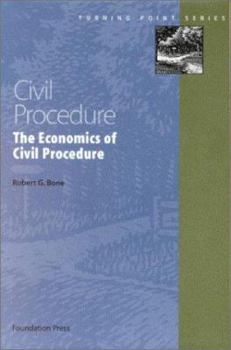
Civil Procedure: The Economics of Civil Procedure (Turning Point Series)

Civil Procedure: Economics of Civil Procedure describes one way to make these policy tradeoffs: the approach of law-and-economics. The law-andeconomics literature has devoted a good deal of attention... This description may be from another edition of this product.
Format:Paperback
Language:English
ISBN:1587781727
ISBN13:9781587781728
Release Date:January 2003
Publisher:Foundation Press
Length:312 Pages
Weight:0.70 lbs.
Dimensions:7.3" x 0.8" x 4.8"
Customer Reviews
1 rating
Essential
Published by Thriftbooks.com User , 20 years ago
The author, a professor at Boston University School of Law, manages to fit a large body of literature in a handy book of 300 pages. The content of the book is coherent with its title: The Economics of Civil Procedure; and deals with the tools of both positive and normative economics applied to the rules of civil procedure. The orientation is only toward the US law (but can be applied universally) and the goal is to provide analytical tools. The author's academic approach is also able to fit a more policy oriented reader and provide some hints for the current debates in the US. The author tackles a) the puzzle of frivolous litigation, and if frivolous litigations really happen in US Courts; b) the puzzle of settlement, or why lawsuits seldom go to trial; c) the optimal pleading rule; d) efficiency of American vs British rule about who is going to pay the attorney's fees; e) the process of discovery; f) preclusion and the class action. It is a very good starting point to get together a growing literature on the subject.
Copyright © 2025 Thriftbooks.com
Terms of Use | Privacy Policy | Do Not Sell/Share My Personal Information | Cookie Policy | Cookie Preferences | Accessibility Statement
ThriftBooks ® and the ThriftBooks ® logo are registered trademarks of Thrift Books Global, LLC
ThriftBooks ® and the ThriftBooks ® logo are registered trademarks of Thrift Books Global, LLC
