


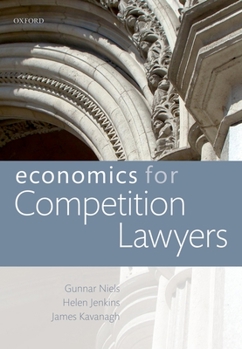
Economics for Competition Lawyers
No Customer Reviews

Why, in the context of a damages claim, are competitive industries more likely to pass on cost increases to consumers than less competitive industries? When can a merger or joint venture result in lower prices, even if there are no cost efficiencies? How can it be rational for a network provider to offer its services below cost in the early stages of network development, regardless of whether there are competing networks? Economics for Competition Lawyers answers all these questions and explains the underlying economic principles most relevant for competition law. An accessible practitioner textbook, written in the tone of an economic expert's report to a high court judge, the book is aimed specifically at competition lawyers, be they solicitors, barristers, in-house counsel, lawyers at government agencies, judges, or students. Practitioners of competition law worldwide need at least a basic grasp of economics, and some of the most successful competition lawyers are those with a solid foundation in economics. This is not only because the most basic premise of competition law - "competition is good, monopoly is bad' - comes from economic theory, but also because economics provides many of the standard tools now commonly applied in competition investigations, such as the SSNIP test for market definition. Also, the substantive standards applied to mergers and business practices increasingly take account of economic effects on the market, and this requires reference to economic "theories of harm." This book therefore explains from first principles the economics that underpin market definition, market power/dominance, mergers, and anti-competitive practices, and shows how this knowledge can be applied in competition cases. For example, it goes beyond the standard explanation of the SSNIP test to cover issues such as when and how to define separate markets because of price discrimination. Likewise, on the matter of market shares, the book goes back to first principles to explain in which circumstances it is more appropriate to measure market shares by capacity than by turnover. It uses plain English and real-world examples, not abstruse theory, to explain the key points. It also offers valuable insight into how to best use economics, or economic experts, in the course of a case.
Format:Paperback
Language:English
ISBN:0199588511
ISBN13:9780199588510
Release Date:May 2011
Publisher:Oxford University Press
Length:640 Pages
Weight:2.45 lbs.
Dimensions:6.8" x 1.5" x 9.7"
Related Subjects
LawCustomer Reviews
0 rating
Copyright © 2026 Thriftbooks.com Terms of Use
| Privacy Policy | Do Not
Sell/Share My Personal Information | Cookie Policy | Cookie Preferences | Accessibility Statement
ThriftBooks® and the ThriftBooks® logo are registered trademarks of Thrift Books Global, LLC
ThriftBooks® and the ThriftBooks® logo are registered trademarks of Thrift Books Global, LLC
