


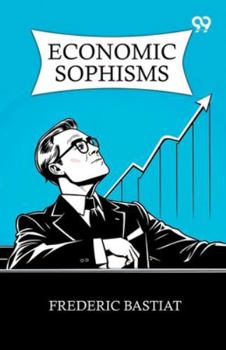
Economic Sophisms


Select Format
Select Condition 
Book Overview
Economic sophisms is a collection of essays that challenges the misconceptions and fallacies underlying restrictive trade policies. Written with clarity and irony, the work presents a strong defense of free trade and economic freedom against the doctrines of protectionism that favor narrow producer interests. The author argues that the prosperity of society depends on encouraging abundance rather than scarcity, revealing how attempts to shield industries through tariffs ultimately harm consumers and distort natural economic balance. Each essay applies logical reasoning and vivid illustration to expose how misguided economic thinking can lead to inefficiency and injustice. The text moves beyond theoretical debate, emphasizing the moral and social implications of economic policy. By highlighting the interdependence between production and consumption, it urges the reader to view trade not as a competition but as a cooperative mechanism that advances collective well-being. The work remains a foundational contribution to the understanding of economic liberty and rational policymaking.
Format:Paperback
Language:English
ISBN:937340170X
ISBN13:9789373401706
Release Date:October 2025
Publisher:Double 9 Books
Length:226 Pages
Weight:0.59 lbs.
Dimensions:0.5" x 5.5" x 8.5"
Customer Reviews
3 ratings
A Classic Primer
Published by Thriftbooks.com User , 16 years ago
This book is 150 years old, and yet many people do not understand its lessons even though it is easy and fun to read. It is fitting that my 1964 FEE edition of this book has an introduction by Henry Hazlitt. Hazlitt's "Economics in One Lesson" is more analytical and less humorous than "Economic Sophisms" but the two are classics in introductory economics. Bastiat's starting point is that desirable economic decisions come from viewing voluntary exchange through the consumer's eyes rather than through the producer's. For example, the "negative railway" highlights the fallacy of adding barriers to productivity in order to increase the costs of transportation. By breaking the tracks from France to Spain, the City of Orleans and its hotels, boatmen, and porters benefit since goods need to unloaded and moved to a new train and passengers are made to disembark. This looks good for producers but terrible for consumers. Especially since following this logic would mean that every city along the tracks should also tear down the rails! The genius of this book is that Bastiat does not need lengthy discussions of externalities and production frontiers to get his point across. Through the simple illustrations, the reader learns these concepts anyway even without being formally introduced to them.
Opponents of Logic Beware
Published by Thriftbooks.com User , 24 years ago
Bastiat does some gentle and not so gentle poking fun at the Trade Luddites of his era. His defense of free trade is no less relevant today. In fact, with the nonsense we are hearing about trade from political and activist quarters - it is probably even more important today.
An outstanding source in "common sense" economics.
Published by Thriftbooks.com User , 26 years ago
This is a book that I first read about fifteen years ago, and the wonderful stories provide vivid examples for evaluating, or countering, "new" economic ideas with common sense historical, or allegorical, counterparts.Protectionists, beware - this book will change you forever.
Copyright © 2026 Thriftbooks.com Terms of Use
| Privacy Policy | Do Not
Sell/Share My Personal Information | Cookie Policy | Cookie Preferences | Accessibility Statement
ThriftBooks® and the ThriftBooks® logo are registered trademarks of Thrift Books Global, LLC
ThriftBooks® and the ThriftBooks® logo are registered trademarks of Thrift Books Global, LLC
