


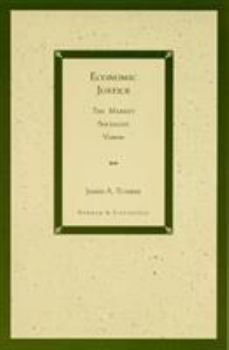
Economic Justice: The Market Socialist Vision


Select Format
Select Condition 
Book Overview
This volume thoroughly examines the case for democratic market socialism in light of both the real-world and intellectual history of socialism. James Yunker provides a clear and jargon-free account of this highly controversial issue. Covering the history of the market socialist idea from the precursors of Oskar Lange to the present, Yunker examines the subject not only in terms of formal economic theory, but in the context of the actual history of communistic socialism as practiced in the U.S.S.R., Eastern Europe, the P.R.C., and elsewhere. The book's historical content and readability will make it of great interest not only to economists and historians of socialism, but to any reader seeking to learn more about the place of market socialism in history and its potential for future application.
Format:Paperback
Language:English
ISBN:0847684776
ISBN13:9780847684779
Release Date:May 1997
Publisher:Rowman & Littlefield Publishers
Length:416 Pages
Weight:1.35 lbs.
Customer Reviews
1 rating
scrupulous, tempered and enlightening
Published by Thriftbooks.com User , 27 years ago
This book is already unjustly neglected, just 2 years after its publication. Yunker's case for "profit-oriented market socialism" is, if not completely convincing, definitely an eye-opener. His awareness of the issues is highly admirable, including even a brief discussion of the nature of socialist and capitalist rhetoric, and praiseworthy in his insistence on not following in the footsteps of previous socialists who have occasionally been too idealistic and optimistic, too inflamed in their rhetoric, too self-assured of their utopian visions. In fact, much of Yunker's criticism is aimed at the excesses of past advocates for socialism.Not that he's easy on what he calls "capitalist apologists," though. His attempts to take seriously their objections and dismantle them in a systematic, orderly fashion are commendable and thought-provoking -- he avoids strawmen like the plague. His rare lapses into invective are forgiveable, too, especially since Yunker's "invective" is exceedingly mild.Yunker's proposal is repeatedly stressed as tentative; he insists that he thinks (democratic) market socialism would work, but says that it's impossible to say without firm empirical evidence, i.e. an economy actually employing some form of market socialism. He discusses the U.S.S.R. and China as two major examples of socialism, even giving 12 points for why the U.S.S.R. fell _besides_ its socialist economy (one of them being, of course, its complete lack of democracy).It's unfortunate that Yunker's thoroughly sensible, responsible advocacy for market socialism has been largely ignored for 20+ years, but no surprise: from what I gather reading this book, he simply has too much faith in the intelligence of his readers. Normally one would admire someone for this, and I certainly do, but the fact is that as long as people are more easily moved by poorly though-out rhetoric, superficially impressive arguments, and all the rest of it -- as long as all these things are predominant, a book like Yunker's just won't convince the masses. A shame.
Copyright © 2026 Thriftbooks.com Terms of Use
| Privacy Policy | Do Not
Sell/Share My Personal Information | Cookie Policy | Cookie Preferences | Accessibility Statement
ThriftBooks® and the ThriftBooks® logo are registered trademarks of Thrift Books Global, LLC
ThriftBooks® and the ThriftBooks® logo are registered trademarks of Thrift Books Global, LLC
