


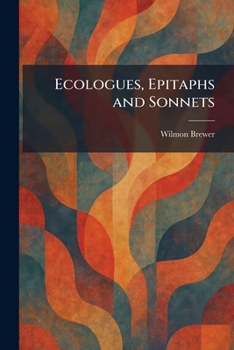
Ecologues, Epitaphs and Sonnets

"Ecologues, Epitaphs and Sonnets" is an evocative collection of verse that showcases Wilmon Brewer's mastery of traditional poetic forms and his deep engagement with classical literary traditions. The volume is structured into three distinct parts, each demonstrating a different facet of the poet's skill and thematic focus. The first section, featuring his ecologues, revives the pastoral tradition through vivid depictions of nature and rural life, channeling the spirit of ancient bucolic poetry into a contemporary context.
The collection continues with a series of epitaphs, offering brief but profound reflections on mortality, memory, and the passage of time. These poems serve as poignant commemorations, balancing solemnity with a refined artistic touch. The final section is dedicated to sonnets, where Brewer utilizes the rigors of the fourteen-line form to explore complex emotions, intellectual observations, and the beauty of the natural world. Throughout the work, the language is characterized by its clarity, rhythmic precision, and adherence to formal structure. "Ecologues, Epitaphs and Sonnets" stands as a significant example of early twentieth-century formalist poetry, appealing to readers who value the enduring power of classical meter and the timeless exploration of life's most fundamental themes.
This work has been selected by scholars as being culturally important, and is part of the knowledge base of civilization as we know it. This work was reproduced from the original artifact, and remains as true to the original work as possible. Therefore, you may see the original copyright references, library stamps (as most of these works have been housed in our most important libraries around the world), and other notations in the work.
This work is in the public domain in the United States of America, and possibly other nations. Within the United States, you may freely copy and distribute this work, as no entity (individual or corporate) has a copyright on the body of the work.
As a reproduction of a historical artifact, this work may contain missing or blurred pages, poor pictures, errant marks, etc. Scholars believe, and we concur, that this work is important enough to be preserved, reproduced, and made generally available to the public. We appreciate your support of the preservation process, and thank you for being an important part of keeping this knowledge alive and relevant.
Related Subjects
PoetryCustomer Reviews
ThriftBooks ® and the ThriftBooks ® logo are registered trademarks of Thrift Books Global, LLC
