


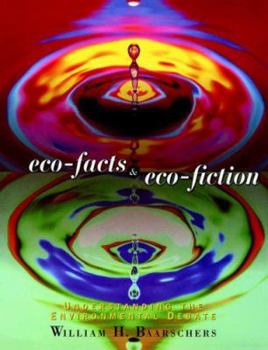
Eco-facts and Eco-fiction: Understanding the Environmental Debate


Drawing on a wealth of everyday examples of inter- national environmental concern, widely held misconceptions and falsehoods are exposed. The author explains basic concepts and provides a more informed environmental understanding.
Format:Paperback
Language:English
ISBN:0415130212
ISBN13:9780415130219
Release Date:May 1996
Publisher:Routledge
Length:280 Pages
Weight:1.60 lbs.
Dimensions:0.6" x 7.5" x 9.8"
Related Subjects
Conservation Earth Sciences Engineering Environment Environmental Science Environmental Studies Human Geography Nature & Ecology Politics & Government Public Affairs & Policy Science Science & Math Science & Scientists Science & Technology Social Science Social Sciences Social Services & WelfareCustomer Reviews
4 ratings
Sorting facts from fantasies
Published by Thriftbooks.com User , 20 years ago
A retired professor of chemistry at Lakehead University, Thunder Bay, Ontario, Canada, the author is also well versed in occupational safety and health. He applies deep and broad knowledge to a number of environmental topics. With clear-minded appreciation for the big picture, his book is balanced, deliberate, educational, and readable. It aims to teach readers how to understand "traps, tricks, and tips of the environmental language." A smattering of points: ? Plants and animals are made of chemicals, water is a chemical, and the air we breathe is a mix of chemicals. A living organism is a system of interacting chemicals. ? Many natural carcinogens occur in food, not in trace amounts like picograms or parts per billion. They occur in gram quantities. Since humans have consumed these for centuries, the conclusion that carcinogenic chemicals are an intrinsic part of the natural environment is inescapable. ? The known number of naturally occurring chemicals that contain chlorine, iodine, bromine, or fluorine in their molecular makeup is now close to 2,000. ? It is important to recognize not only the capabilities of science, but also is limitations. Pseudo-science is characterized by claims of effects caused by an agent of barely detectable intensity, reliant on great accuracy of measurement. This book renders public service by shedding light on why some environmental scares are deservedly en route to oblivion.
Balance & Perspective with Humour
Published by Thriftbooks.com User , 21 years ago
There seems to be so much written about the extreme dangers to which we face each and every day. It would appear that at every turn, the environment is ready to take away the remainder of our lives, and like a predator requires our serious intervention. This type of propaganda has been quite rampant for at least a decade before the publishing of this work. So, while the title is quite sympathetic to the problem of biased reporting, it also provides a balance to what the "lay-ear" hears each and every day. There are other published works that handle the topics, but the difference here is largely one of credentials. Dr. Baarschers claim to fame is not as a populariser of science, but as a seasoned researcher and instructor in Chemistry. Furthermore, the work has been written at the end of an impressive career - it is not meant to make a career for someone. Having laboured under the yoke of trying to make Chemistry a sensible topic to the young adult mind, his pedagogical experience makes it possible to read the science, and have it make sense. Certainly not to be confused with a textbook on Chemistry, I think that the issues themselves are framed such that the average reader can certainly experience a deeper understanding, and with that, an appreciation for the difficulties that we have with environmental reporting.
Objective review of environmental issues
Published by Thriftbooks.com User , 27 years ago
I use this as one of my texts in E100 Environment and People. It presents a balanced approach to show there are problems, but all is not doom and gloom. I hope the author will consider updating frequently to include newer issues as they arise. I developed several questions for each chapter for the students to answer.
Objective review of environmental issues
Published by Thriftbooks.com User , 27 years ago
I use this as one of my texts in E100 Environmenta and People. It presents a balanced approach to show there are problems, but all is not doom and gloom. I hope the author will consider updating frequently to include newer issues as they arise. I developed several questions for each chapter for the students to answer.
Copyright © 2026 Thriftbooks.com
Terms of Use | Privacy Policy | Do Not Sell/Share My Personal Information | Cookie Policy | Cookie Preferences | Accessibility Statement
ThriftBooks ® and the ThriftBooks ® logo are registered trademarks of Thrift Books Global, LLC
ThriftBooks ® and the ThriftBooks ® logo are registered trademarks of Thrift Books Global, LLC
